Learn how partners earn from USDC, the facts on redemption fees, and the infrastructure behind a digital dollar that settles trillions every quarter.
How partners earn from USDC, the truth about redemption fees, and the infrastructure required to power a digital dollar that settles more than $14 trillion each quarter.
In the first half of 2026, USDC settled more than $36 trillion in onchain transaction volume. Circle minted and redeemed more than $315 billion of USDC, about $1.7 billion every day, including weekends and holidays. Circle also paid $819 million for its USDC distribution partners and transaction costs. By June, USDC carried roughly 77% of all global stablecoin transaction volume, up from 60% a year earlier.
Those are the numbers behind a digital dollar in production: trillions in settlement, billions converted to and from fiat every day, and most of the economics flowing to the partners who build on it.
Yet lately, new entrants have claimed they can build a more “useful” stablecoin. The pitch is familiar: issuers keep too much of the economics, redemptions are expensive, and a new model will fix both.
It is an intriguing pitch. It also misrepresents how USDC works today and drastically underestimates what it takes to make a stablecoin useful.
I lead Circle’s commercial business, where my team negotiates the partnerships that put USDC in the world’s leading wallets, exchanges, banks, fintechs, enterprises, and payment networks. Circle has years of experience executing stablecoin partnerships that help customers worldwide access, use, and earn from USDC through a global network of partners. From that vantage point, I want to put the facts and numbers on the table, so anyone deciding where to build can judge the substance for themselves rather than rely on framing or false headlines.
Three points deserve to be stated plainly up front:
- Circle shares the majority of USDC’s economics with the partners that drive its adoption, and has for years.
- All Circle customers have always been able to redeem for free through standard rails, with settlement in up to two business days. Additionally, all customers who move flows over the Circle Payments Network or build on the Circle Platform can now redeem USDC for free, with near-real-time, 24/7/365 settlement capabilities.
- USDC is, by far, the most useful stablecoin in the market by the measures that matter to businesses, and the gap is widening because Circle has spent more than 8 years building and investing in the infrastructure behind it.
Let’s dive in.
How USDC's revenue is distributed
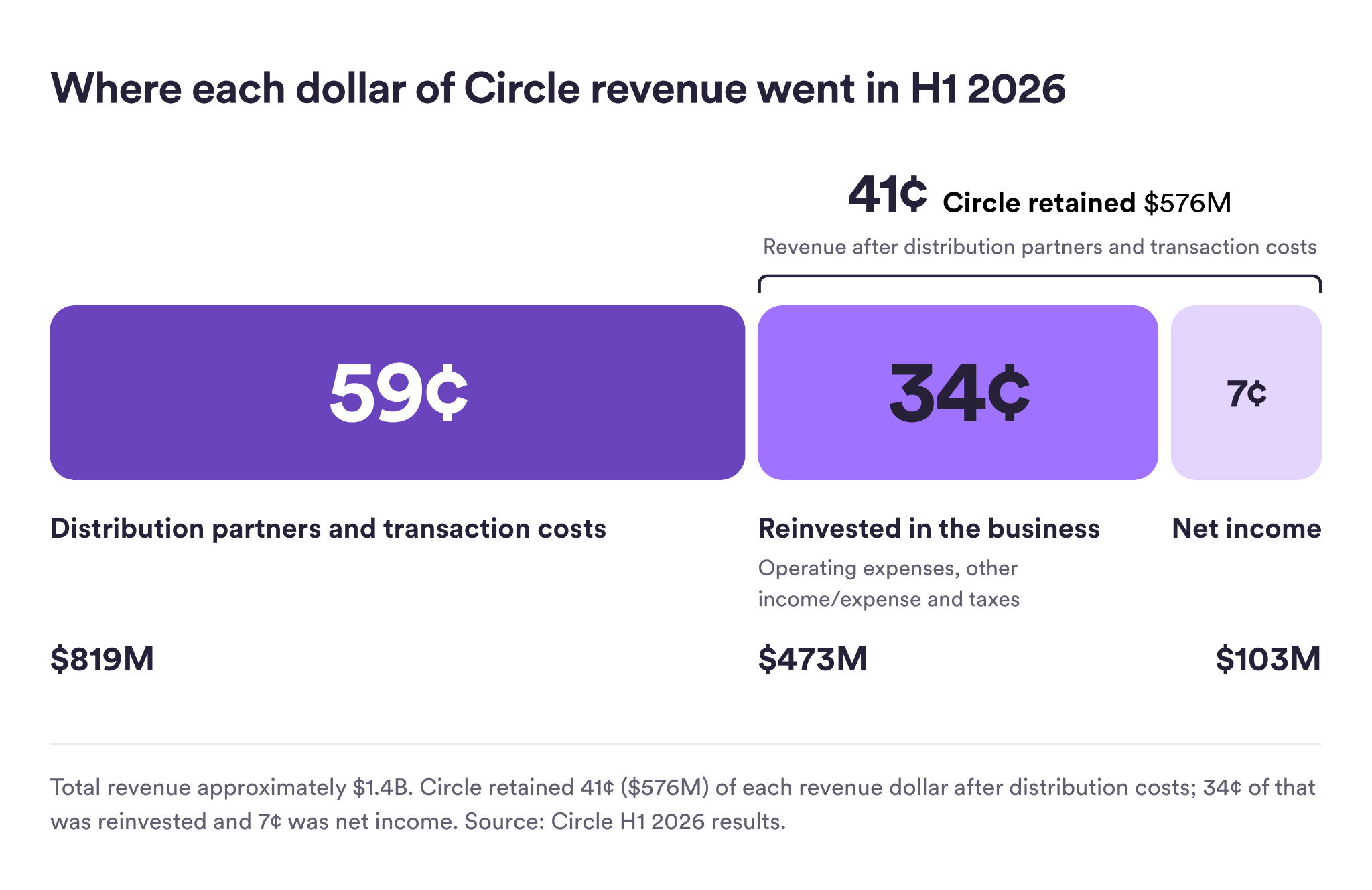
In the first half of 2026, Circle generated approximately $1.4 billion in revenue and paid approximately $819 million of it to USDC distribution partners and transaction costs. Approximately 59 cents of every dollar of revenue went to the global partners that make USDC available across wallets, exchanges, banks, fintechs, enterprises, and payment networks worldwide.
We reinvested the vast majority of what remained in the network. Circle spent about $473 million, roughly 34 cents of every dollar, on the licenses, banking relationships, settlement liquidity, compliance programs, new product investments, and blockchain integrations that make USDC the world’s most useful, compliant, and licensed stablecoin. Circle made 7 cents of net profit from every dollar of revenue earned.
That reinvestment is not overhead. It is what makes USDC useful, and it reflects more than 8 years of building. A digital dollar has to work everywhere: redeemable at any hour, held by regulated institutions, and moving natively across the chains and platforms where businesses operate. That means licenses across the world’s major jurisdictions, so a bank in Europe, a fintech in Latin America, and a payment network in the United States can use the same dollar under their own rules. It means native deployments on dozens of blockchains and the interoperability to move between them. And it means the liquidity and banking relationships to honor billions in mints and redemptions every day, in every major financial market center around the world. Without that foundation, a stablecoin is not a digital dollar; it is a token. This is what new issuers leave out when they promise to share the “substantial majority” of their economics: a stablecoin that distributes everything but funds nothing. The costs of redemption, compliance, and resilience don’t disappear just because the issuer declined to pay them. Every dollar Circle reinvests widens that gap.
So the real question is not whether reserve income should flow to the businesses building on a stablecoin. USDC’s financials settle that. The question is how much can be shared while continuing to fund the infrastructure that makes the stablecoin useful in the first place. The rest of this piece answers it: how partners participate, how redemption works, and what that infrastructure actually costs.
How partners participate in USDC economics
Distribution economics follow adoption: the partners that bring the most USDC to market earn the most. Coinbase, our largest and longest-standing partner, is the clearest example. In its second-quarter results, Coinbase reported that average USDC held in its products reached an all-time high of $20 billion, up 44% year over year.
But Coinbase is one partner in a much larger network. In September, Binance, the world’s largest exchange, signed a five-year commercial agreement and invested $100 million in Circle. More than 150 other partners have an economic interest in USDC’s growth, spanning the financial system and the businesses that run on it: exchanges, wallets, neobanks, fintechs, payment platforms, banks, and enterprises. That broad base of participation is why USDC carried roughly 77% of global stablecoin transaction volume in June, up from 60% a year earlier.
The model itself is simple. Partners participate in USDC’s economics in two ways.
- Bring and grow balances, then earn on them. Distribution partners that hold and grow USDC balances on their platforms earn a share of the reserve income generated by those balances. The more USDC a partner drives, the greater the share.
- Build on the platform and redeem for free. Customers who move payment flows over the Circle Payments Network or build on the Circle Platform through Arc, Circle Mint, or Circle Wallets can redeem for free in near real time. The next section covers exactly how that works.
The facts on redemption
Redemption has drawn the most confusion, so I want to be exact. The world’s largest payment networks, including Visa and Mastercard, settle in USDC seven days a week, including when the banking system is closed. Payment companies around the world rely on Circle’s infrastructure to convert USDC to dollars because it works at scale every day of the year.
In the first quarter of 2026 alone, Circle redeemed $71.8 billion in USDC, roughly 90% of the total supply in circulation at the time. In the second quarter, combined minting and redemption volume reached $170 billion, up 105% year over year. No other stablecoin issuer processes fiat redemptions at a comparable scale.
Circle’s redemption terms rest on three principles:
- Every Circle customer can redeem USDC for free. Redemptions through standard banking rails typically settle in up to two business days.
- Payment flows on Circle Payments Network (CPN) can now settle in near real time, for free. Businesses that use USDC as a payment rail on CPN, including card networks, processors, remittance providers, enterprise, and fintechs that settle real volume, can now redeem in near real time at no cost. Payments companies globally are invited to join CPN, where this capability is built in.
- Circle Platform customers can now qualify for free near-real-time redemption in several ways. This includes holding USDC balances on the Circle Platform and building with Circle through CPN, Arc, Circle Mint, Circle Wallets, and other eligible products. Qualified customers redeem for free in near real time.
What makes that settlement speed possible is liquidity. To process redemptions in near real time rather than over days, at any hour and at any size, Circle holds a substantial pool of cash at its global network of bank partners, pre-positioned and ready to leave the moment a redemption is confirmed onchain. That cash has to stay liquid, so it earns less than it would in Treasuries. And it has to be available at every hour, including when the banking system is closed, which means maintaining the bank relationships and settlement rails that can move it on demand. We carry that cost so customers don’t have to wait. This liquidity is the most important and most expensive part of the redemption model, and we do not charge for it when a customer participates in the network.
Building a globally trusted digital dollar
Anyone comparing stablecoin models should look past the headline economics and ask a harder set of questions: can the issuer honor redemptions at any hour, operate through stress, maintain compliance across jurisdictions, and keep investing over time? Regulators ask the same questions. A stablecoin is not a software product. It is monetary infrastructure, and it has to be financially sound.
Circle has lived this tradeoff firsthand. USDC launched in 2018 as a consortium project. In 2023, Circle took full governance and rebuilt the model around a simple principle: the issuer must have the capacity to invest in the network. That decision accelerated everything that followed, and more than 8 years of investment sit behind every dollar of USDC.
Those investments include more than 55 licenses and registrations, including an OCC national trust bank charter and compliance with MiCA; relationships with more than 25 partner banks, including systemically important institutions; reserves in a government money market fund managed by BlackRock and custodied at BNY, with monthly attestations; global compliance and sanctions programs across 185 countries; native deployments on over 35 blockchains; and the liquidity to honor roughly $1.7 billion in daily mints and redemptions.
That is what utility looks like at scale. USDC is used for settlement by major payment networks, held as a reserve asset by a growing number of banks, and used by developers as the default dollar for onchain applications. The industry depends on it: more than 70% of the companies on recent consortium launch rosters already build on USDC. They are all partners we value, and we expect to keep building with them.
In summary
USDC’s model is built as a flywheel, so the entire ecosystem wins. The majority of its economics goes to the partners that drive adoption, every customer can redeem for free, and what Circle retains goes back into the infrastructure that makes USDC the most useful stablecoin in the world. Each turn reinforces the next. Partners grow USDC because they share in its economics. That growth funds more licenses, liquidity, and chains. A more useful digital dollar then draws in the developers, businesses, and users who become the next wave of adoption. That model has held through every market cycle since USDC launched more than 8 years ago, and we will keep investing to make it stronger for the next one.
Circle has built the industry’s broadest and most deeply integrated stablecoin ecosystem across distribution, payments, banking, trading, and blockchain infrastructure. If you are deciding where to build, we are ready to build with you.
USDC is issued by regulated affiliates of Circle. See Circle’s list of regulatory authorizations.
Circle Technology Services, LLC (CTS) is the operator of Circle Payments Network (CPN) and offers products and services to financial institutions that participate in CPN to facilitate their CPN access and integration. CPN connects participating financial institutions around the world, with CTS serving as the technology service provider to participating financial institutions. While CTS does not hold funds or manage accounts on behalf of customers, we enable the global ecosystem of participating financial institutions to connect directly with each other, communicate securely, and settle directly with each other. CTS is not a party to transactions between participating financial institutions facilitated by CPN who use CPN to execute transactions at their own risk. Use of CPN is subject to the CPN Rules and the CPN Participation Agreement between CTS and a participating financial institution.
Arc is an open L1 blockchain launched by Arc Network Services LLC ("Arc LLC") and operated by a permissioned validator set. Arc LLC provides software services only and does not offer regulated financial or advisory services. Arc has not been reviewed or approved by the New York State Department of Financial Services or any other regulatory authority.
The Arc network is provided "as is" and "as available." Use of Arc involves inherent risks associated with blockchain technology, including smart contract vulnerabilities, network disruptions, and the absence of recourse for transaction errors or losses. The ability to transact on Arc depends on the ability to obtain and use USDC to pay gas fees. Neither Arc LLC nor any permissioned validator is responsible for the content, accuracy, legality, or functionality of third-party applications, protocols, or services built on or integrated with Arc. You are solely responsible for features or services you provide to users, including obtaining any necessary licenses or approvals and otherwise complying with applicable laws.
All Arc features may be modified, delayed, or cancelled at any time without notice. Nothing herein constitutes a commitment, warranty, guarantee or legal, regulatory, tax, or investment advice.
Circle Mint and money transmission services are provided by Circle Internet Financial, LLC. Circle Internet Financial, LLC, NMLS # 1201441, is a licensed provider of money transmission services. See Circle’s licenses here. Circle Mint is currently available only to institutions and is not available to individuals.
Circle Wallets are provided by Circle Technology Services, LLC (“CTS”). CTS is a software provider and does not provide regulated financial or advisory services. You are solely responsible for services you provide to users, including obtaining any necessary licenses or approvals and otherwise complying with applicable laws. For additional details, refer to the Circle Developer Terms of Service.
The term “partner” refers to companies with which Circle has commercial agreements to grow the adoption and use of USDC, and does not necessarily refer to a legal partnership, joint venture, or fiduciary relationship.