
The full-stack platform for the agentic economy


Legacy finance isn’t built for AI. Agent Stack is.
Agent Stack is purpose-built for AI from the protocol up. It delivers the tools developers use to ship AI-powered applications and the financial primitives agents need to hold value, discover services, and transact programmatically.
Powered by USDC
USDC is the trusted standard for agentic payments — stable, liquid, regulated1, and programmable. With USDC, agents can move money 24/7, settling at near-zero cost and machine speed.
Multichain and multi-protocol
Agents transact across supported chains via x402, with new agentic payment protocols added as they emerge. No chain- or protocol-specific complexity to manage.
Open, composable building blocks
The financial primitives developers need to equip agents to hold assets, move value, and pay for services. Open by default, composable into any application.
One stack. End to end.
Agent Stack forms a complete economic loop. Build, command, and discover agentic financial building blocks. Programmatically hold, transfer, and settle USDC.
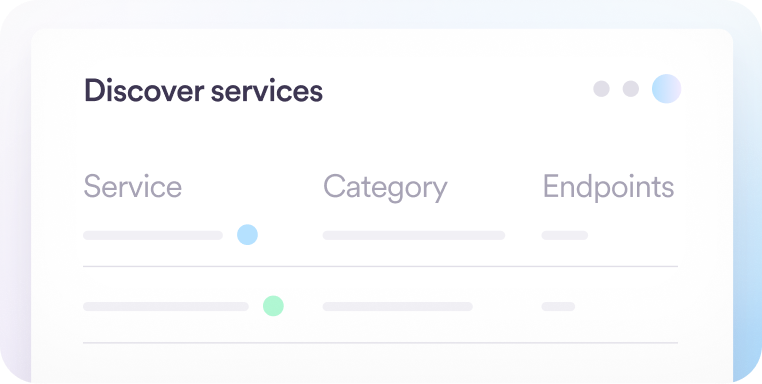
Agent Marketplace
A directory where agents discover, evaluate, and pay for services in USDC. Structured for machine reading and open for agentic participation.
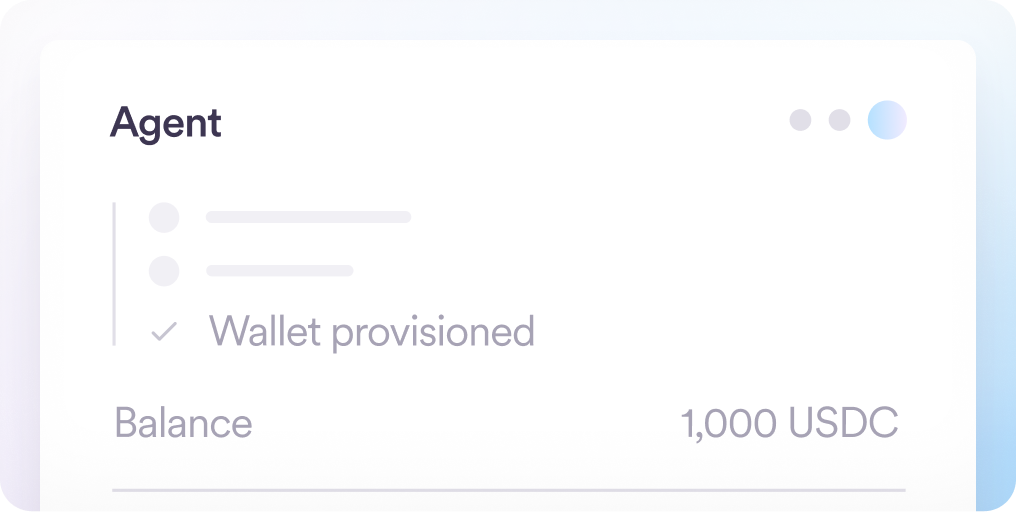
Agent Wallets
Programmable USDC wallets for agents, with global limits, per-service caps, contract or chain allowlists, and time-bounded sessions built in.
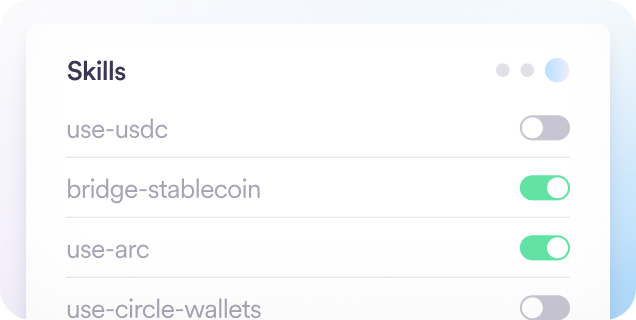
Circle Skills
Best practices for agentic USDC payments, crosschain transfers, wallets, and smart contracts, plus Circle’s MCP server for the latest SDK and documentation.
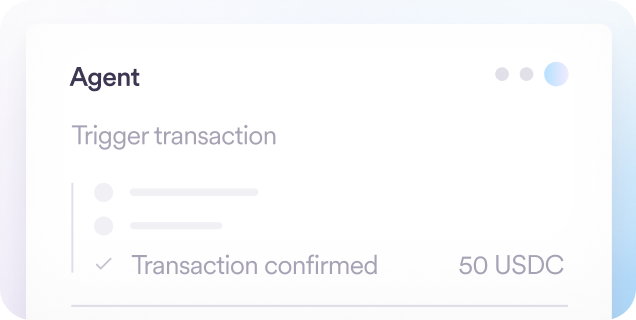
Circle CLI
An agent-native command line interface for humans and agents to create wallets, define policies, discover services, and trigger transactions.
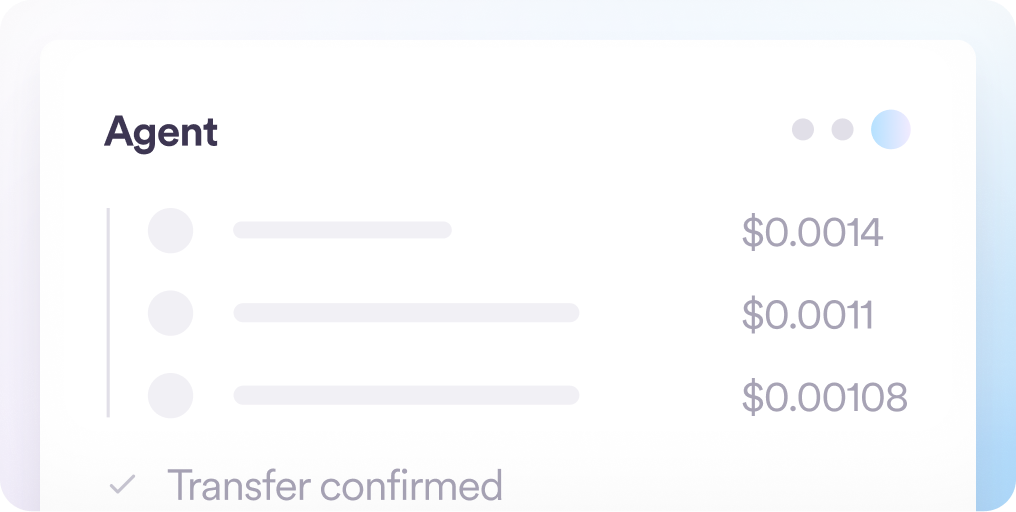
Nanopayments powered by Gateway
Sub-cent, gas-free USDC payments built for the high-frequency, machine-speed transactions agents need to operate.
From assistant to economic actor
"Pull context, pay a research service, and draft the brief."
"Buy a phone number, scan X for trends, then call with a 30-second brief and take questions live."
"Rank 30 days of posts by engagement. Surface top 5, bottom 5, and what hit vs. flopped."
"Pull this week’s top AI research. Return 5-8 papers or blog posts plus a short 'why it matters' on each."
Make every endpoint a storefront
List your API endpoint, accept USDC, and get paid per call. No checkout pages, no signup flows, no monthly contracts.
Empower your agents
Build with the agent-native CLI, create agent wallets, and connect to the rest of Agent Stack.

FAQs
Circle Agent Stack is a chain- and protocol-agnostic infrastructure purpose-built for the agentic economy, empowering agents to hold assets, transact, and access services across ecosystems.
USDC is already emerging as the default money for agents, powering 99.8% of x402 transaction value. It is stable, regulated1, globally accessible, and designed for programmability. Agents need predictable value and reliable settlement, and USDC provides both at scale.
This enables models that were previously not economically viable, such as pay-per-call APIs, real-time compute pricing, and high-frequency microtransactions. It also lays the groundwork for agent-to-agent transactions and more complex forms of machine-driven commerce.
The long-term vision is an economic system where agents can discover, decide, and transact autonomously. Payments become embedded into execution, and value moves programmatically across open, interoperable infrastructure. This is the foundation of the agentic economy.
Onramp, Transfer, Execute contract calls, Sign, Bridge, Trade/Swap, Pay for endpoints via Nanopayments.
Arbitrum, Arc testnet (mainnet coming soon), Avalanche, Base, Ethereum, Monad, OP Mainnet, Polygon PoS, Unichain
A spending policy is a set of programmable rules that restrict how an agent wallet can move funds or interact with smart contracts. These rules provide a layer of "onchain governance" to prevent unauthorized or excessive spending by an autonomous agent.
Services are validated and listed in a structured, machine-readable format that includes pricing, capabilities, and invocation methods. Agents can query the registry to find services relevant to their task on a one-off basis, or programmatically with the Discovery API.
Agents pay using USDC through Nanopayments or supported protocols like x402. Payment is embedded in the request, so access and payment happen in a single step without separate billing or authentication flows.
Any service that can be accessed programmatically, including APIs (LLM inference, data access), compute services, infrastructure services, digital goods, or content.
Visit https://forms.gle/7YFzvdmMcn1JH5tF6 to submit your service. We encourage all service providers and builders to list their endpoints and help unlock the agentic economy together.
1 USDC is issued by regulated affiliates of Circle. See Circle’s list of regulatory authorizations.
Circle Technology Services, LLC (“CTS”) is a software provider and does not provide financial, advisory, or marketplace services. Agent Stack enables users and developers to interact with third-party applications and services, which are not controlled by Circle. Transactions initiated by agents are executed based on user-defined permissions and may occur without real-time human review. Circle does not guarantee the performance, availability, or outcomes of any third-party services or agent-initiated transactions. Users are solely responsible for their use of these tools and for evaluating associated risks.
For additional details, please see the Circle Developer terms of service, available at agents.circle.com/terms-of-use.