Circle Nanopayments can enable transfers as small as $0.000001, making it viable for pay-per-crawl and agentic economic activity. Learn more about Circle Nanopayments.
The internet is currently undergoing a significant structural transformation as it shifts from a human-centric web to one that is increasingly agent centric. Autonomous agents are sophisticated programs capable of reasoning, planning, and executing multi-step workflows across disparate systems without direct human intervention. As these agents go about executing their tasks, they need to pay continuously, programmatically, and in tiny increments for API calls, content, inference, and compute.
Traditional payment rails are not designed to support high frequency sub-cent payments due to fixed fees, settlement latency, and operational overhead. In contrast, stablecoins like USDC enable transfers as small as $0.000001, making USDC viable for agentic finance, commerce, and payments.
The x402 protocol: Standardizing payments for agents
x402 is emerging as the standard protocol for agents to pay on the web. It revives the old HTTP status code 402 Payment Required. x402, developed by Coinbase, allows any agent to pay any merchant without first needing to create an account or add a credit card.
Challenges of sub-cent payments
While blockchains and stablecoins theoretically enable the transfer of value at any scale, the economic reality of network fees, transaction latency, and interoperability renders high-frequency, sub-cent payments impractical.
Gas economics at sub-cent denominations
When a sub-cent transfer is settled as an individual onchain transaction, transaction fees dominate the payment value. Even on low-cost chains, this makes many sub-cent payments economically infeasible.
*These calculations are based on the avg. base fee for the chain in 2025. It doesn’t include the priority fee which is usually incurred as well and can increase the transfer costs further.
Reliable throughput and predictability
Public blockchains are shared infrastructure. Even networks with high peak throughput cannot guarantee consistent capacity or latency for a single use case, as throughput is influenced by third-party network demand and gas market dynamics.
Sub-cent payment use cases such as pay-per-crawl require predictable processing capacity and low latency at high request volumes, which is difficult to guarantee when each payment competes directly in a public mempool.
Interoperability and verification complexity
Buyers (AI crawlers or agents) and sellers (publishers) often operate on different blockchain networks. To accept payments broadly, sellers must either:
- Perform transaction verification across multiple chains, or
- Rely on a facilitator to handle verification and settlement on their behalf.
This introduces operational complexity for sellers and increases the integration burden, particularly for publishers that are not crypto-native.
Circle Nanopayments: Offchain aggregation with onchain finality
To address these challenges we built Circle Nanopayments, a solution that combines offchain aggregation with onchain finality.
Here is the step-by-step flow of a payment using Nanopayments:
- Fund a unified balance: An agent makes a one time USDC deposit into the Circle Gateway smart contract. This funds the agent’s available balance for Nanopayments.
- Request a paid resource: The agent requests a resource from a merchant’s API. The merchant responds with 402 Payment Required and the payment details.
- Sign a payment authorization: To complete the payment, the agent signs an EIP-3009 authorization for the requested amount (e.g. $0.000001)
- Submit the payment: The agent retries the request with the signed authorization, and the merchant submits it to Nanopayments for verification — either directly, or via a Nanopayments integrated facilitator.
- Verify instantly: Nanopayments validates the signature against the agent’s available balance and immediately deducts the amount from the agent’s offchain balance.
- Confirm payment: Nanopayments returns a successful response to the merchant. From the merchant’s perspective, the payment is final, so the API response or digital resource can be released immediately.
- Settle onchain asynchronously: Nanopayments batches thousands of signed authorizations, verifies them in a Trusted Execution Environment, and periodically submits a single batch transaction onchain. Once that batch finalizes, the corresponding onchain balances are updated and the offchain balances remain aligned with the settled state.
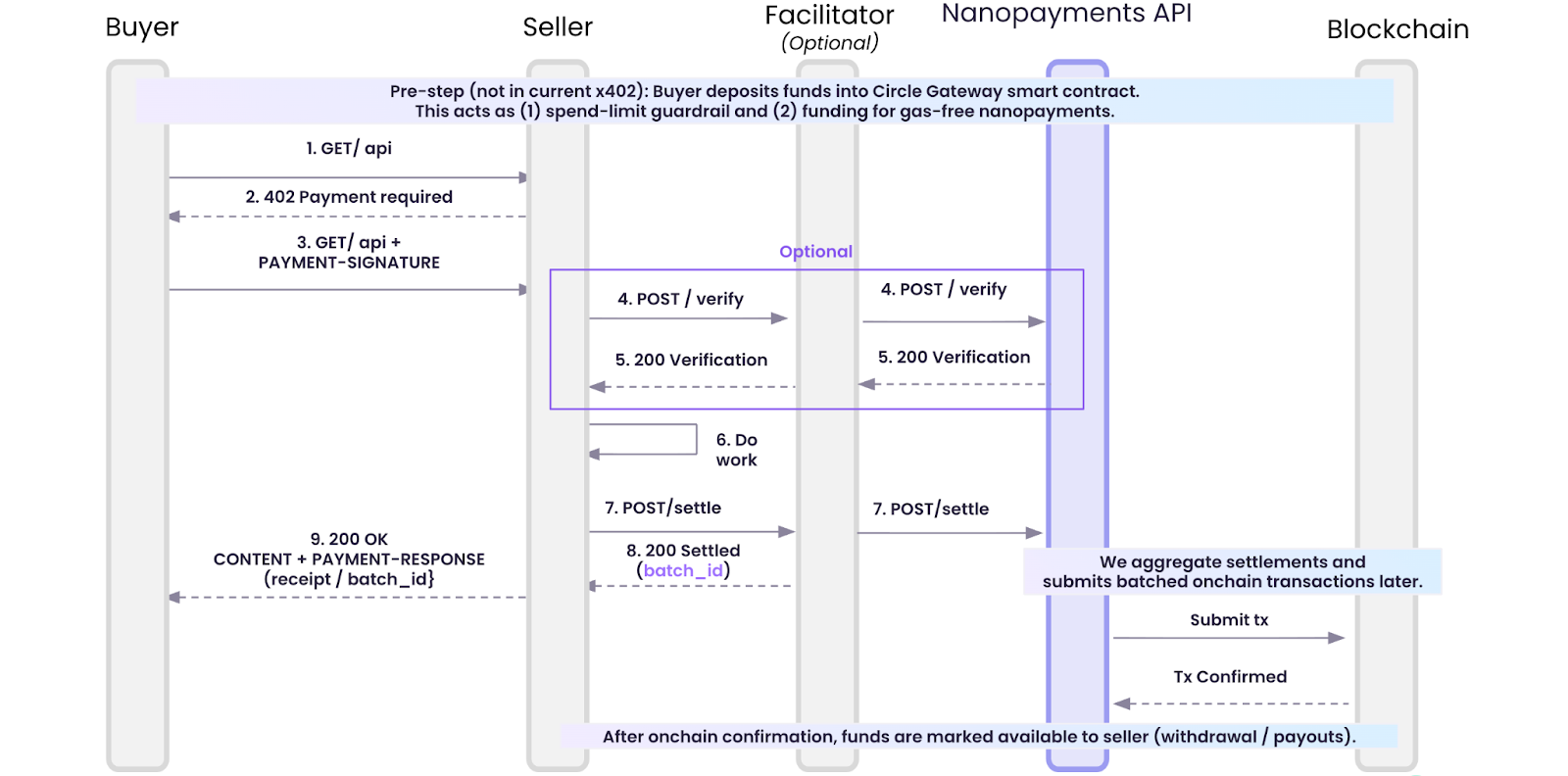
Our solution, Nanopayments, addresses all the bottlenecks of agentic sub-cent value transfers.
Gas economics
With Nanopayments, sub-cent transactions are aggregated offchain and settled onchain in batches. This removes the need for per-payment gas fees and makes ultra-small transfers gas free to the payer, while still incurring gas costs at the batch settlement level.
Throughput and predictability
Because Nanopayments transactions are aggregated offchain and settled in batches, throughput can be scaled independently of public blockchain congestion. This in turn allows predictable and reliable capacity tailored specifically for sub-cent workloads.
Interoperability and liquidity management
Powered by Gateway, Nanopayments abstracts much of the complexity of interacting with multiple blockchains. Once funds are deposited into Gateway, sellers interact with a single, consistent API regardless of the originating chain. Balances held within Gateway can be reallocated across supported chains. Funds originating from multiple chains can be consolidated or redistributed instantly via Gateway, rather than requiring separate onchain settlement flows on a per-network basis.
x402 compatibility
Our solution preserves standard x402 v2 request and response semantics. The enhancements are limited to how payments are aggregated, verified, and settled, rather than altering the x402 protocol itself.
Trust assumptions and security
Circle Nanopayments builds on Gateway’s non-custodial design. Payments can only be processed from authorizations signed by the agent’s private key, which means Circle cannot forge payments or initiate them on a user’s behalf.
Signed authorizations are verified and batched inside a Trusted Execution Environment (TEE). The TEE signs the batch transaction, and the onchain contract verifies that signature before updating balances, enabling fast offchain confirmation and periodic onchain settlement.
Powering the agentic economy
The emerging agentic economy demands infrastructure capable of processing high-frequency, sub-cent transactions without gas bottlenecks. Nanopayments is that infrastructure.
By enabling gas-free transfers down to $0.000001 while maintaining x402 compatibility and non-custodial security, Nanopayments empowers developers to build scalable applications for machine-to-machine transactions, AI inference payments, and granular usage-based billing — unlocking the wider agentic economy in the process.