Sybil attacks can reverse concave DAO voting mechanisms, giving attackers linear voting power. See how the exploit works and what to do about it.
Learn about DAO Governance mechanisms and how Sybil Attacks can make them unsafe. Our research shows that most useful concave voting functions in DAO governance can be exploited into a one-token-one-vote system under an optimal strategy. This allows attackers to gain control of a system for much less tokens.
DAO governance decentralizes control of onchain functions, updates, and resources. It can be messy; but for many blockchain projects, it is a vital process. Users vote their token holdings to come to collective decisions, allowing for strong community input.
Though not all votes are well-intentioned. On May 20, 2023, an attacker slipped in a self-destruct modification into Tornado Cash code and drained TORN tokens from the treasury. In fact, empirical studies suggest that many proposals have only 5% voter participation; so under most one-token-one-vote DAO governance systems, a large token holder can exert significant influence on the voting system. For this reason, DAO designers have proposed many creative attempts to protect decentralization. The most common are concave voting functions.
These functions assign more votes to bigger wallets, but with lower marginal increments. Proponents claim they’re a way to balance voter intensity with decentralization. Users are still rewarded for large holdings, but they’re also not the only voice in the room. It’s well-intentioned, but our work shows that in permissionless settings these systems can be circumvented.
By continuously splitting their evenly tokens into many small wallets, attackers can effectively reverse the intended dampening effect. In doing so, they threaten the integrity of the DAO.
How Quadratic Voting Tries to Balance Power in DAOs
To demonstrate this issue, consider Quadratic Voting. This gives a voting power equal to the square root of the number of tokens. For example, someone with 100 tokens would have 10 votes and someone with 4 tokens would have 2 votes.
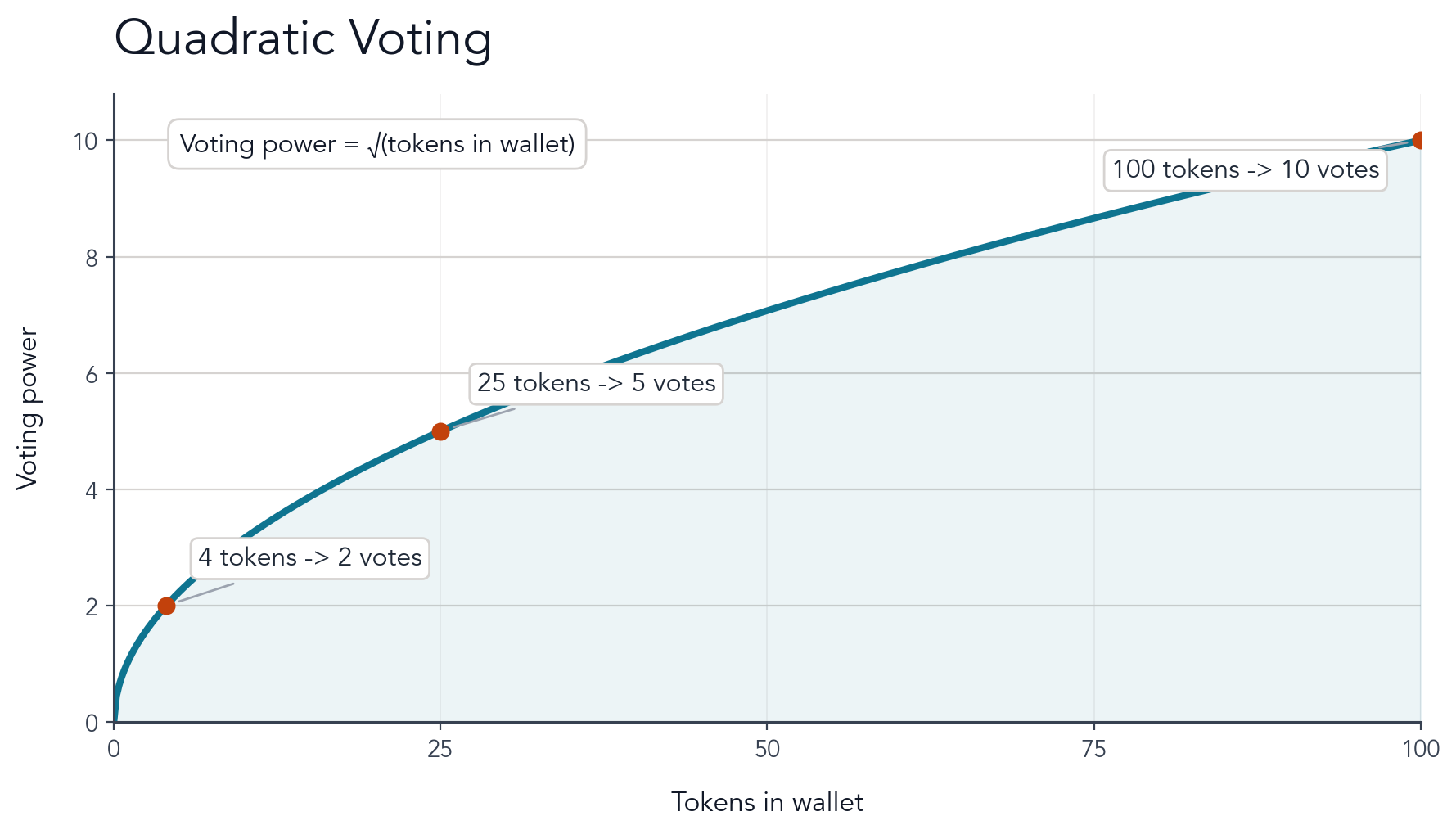
Graph of tokens in wallet against voting power under Quadratic Voting
This works when identities are known, but when attackers can leverage multiple identities (i.e. wallets) the system can collapse into one-token-one-vote. We show that this is true not only for Quadratic Voting, but also any concave function that’s positive, increasing, and finite.
How Sybil Attacks Exploit Concave Mechanisms
This issue with blockchain implementations of concave voting systems is known as a Sybil attack. First defined by John Douceur, the idea is to manipulate decentralized voting systems using fake identities. It’s analogous to stuffing a ballot box with votes.
In permissionless systems, a Sybil-attack lets token owners pretend to be multiple voters by splitting their wallets into smaller ones. One token, one vote systems are unimpacted by this attack. The reason for this is that one token is worth one vote no matter in which wallet it sits.
Concave mechanisms do not have that same guarantee. Under Quadratic Voting, for example, a voter with 4 tokens can increase voting power by splitting their wallet into four 1-token wallets.
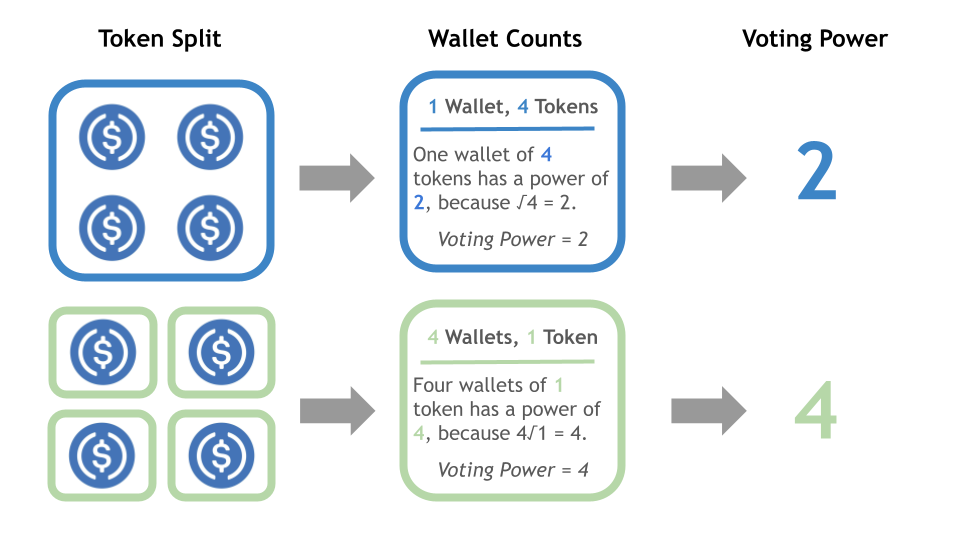
A simplified version of Sybil-Splitting under Quadratic Voting
In the above example, we see that splitting our funds across multiple wallets through a Sybil attack allows us to double our voting power – but why stop there? The smaller the token amount, the greater the marginal benefit that an attacker is able to obtain. Without barriers to splitting (e.g. transaction costs and minimum wallet sizes), an attacker can continue this process indefinitely. Assuming no barriers to wallet splitting, the optimal strategy for Quadratic Voting actually gives infinite votes to an attacker who splits a wallet into infinitesimally small units!
Bringing Sybil Attacks Onchain
In reality, DAO governance isn’t that simple. Attackers consider transaction costs, voting costs, and minimum wallet balances. To combat this, we’ve developed a model that includes those real-world frictions in our most recent paper.
Using this model, we show two things:
- All voting mechanisms that rely solely on wallet size are plutocratic (i.e. attackers can always obtain a voting power that’s at least a linear function of their holdings).
- Most systems that disproportionately reward small holdings (i.e. those that are concave, finite, bounded, and positive) can be undone by Sybil splitting. Optimal strategy gives a voting power with an asymptotically one-token-one-vote relationship with token holdings. This is true regardless of the average protocol fees or minimum wallet balances.
The method for performing voting power maximization is remarkably simple. We show that splitting tokens into equal size wallets is optimal; and therefore, an attacker just needs to optimize for the number of wallets to use. This is a function of protocol fees and makes it easy for DAO designers to estimate. In doing so, they can understand the security risk to their protocol and help safeguard it from attackers.
Building Governance That’s Safe and Fair
In theory, anyone can obtain a linear voting power using this Sybil strategy – so why is having a concave system less secure than one token, one vote?
The answer is that honest participants usually won’t get this power.
Asymptotically linear voting power only happens at the optimum, where you incur large fees for transactions and voting. An attacker likely doesn’t care about the cost of tokens for the network they’re trying to destroy, but honest participants might. They are not incentivized to take on the large costs to split their tokens solely for voting power like an attacker; and if they don’t do so, they usually will only have sublinear voting power growth. The concave mechanism that was supposed to protect them now hurts them.
This doesn’t mean that one-token-one-vote or concave voting systems are inherently superior. The problem is when the mechanism rewards dishonest participants. Our work shows the limits of pure wallet-based voting. DAO designers have other tools available – token time-locks, weighing token age, proof-of-personhood; and hopefully, new systems will be developed to secure concave mechanisms against Sybil attacks. For now, system designers need to be aware of the unintended effect of popular voting functions.
Circle is building for security and we hope that you do too. Whether it’s instituting Anti-Sybil features or using safe voting mechanisms, we encourage careful evaluation of the systems that run our networks. In doing so, we build a better future for onchain finance.