Quantum computing is advancing as the resources needed to attack ECDSA fall. Explore what the quantum gap means for blockchain security and post-quantum migration
Quantum computing capability is climbing, and it is farther along than many people think. At the same time, cryptographers with the help of AI have found more efficient quantum attacks on the Bitcoin and Ethereum signature has fallen dramatically. The gap is closing from both sides, faster than many people expected.
You can rent a quantum computer today. Amazon Braket offers access to multiple quantum hardware providers, including QuEra's neutral-atom machines — no specialized lab required. At the same time, Google just achieved 105 logical qubits with Willow and plans to scale up to 1,000+ logical qubits in its next milestone. QuEra published a roadmap to 1,000+ logical qubits in 2029, available through AWS. Quantum computing has quietly progressed from theory to engineering milestones.
Algorithms for breaking classic cryptography have also improved dramatically. In 2017, breaking the Bitcoin and Ethereum signature ECDSA using Shor's algorithm required an estimated 2,330 logical qubits. That number has been falling steadily as researchers find smarter attack circuits. As of August 2026, the ecdsa.fail leaderboard — an open competition to find the leanest circuit for breaking secp256k1 — sits at 813 logical qubits.
ECDSA and Ed25519 — the two signature schemes that secure the overwhelming majority of blockchain transactions — will likely be the first to fall. Every account that holds digital assets (that previously signed a transaction) may be vulnerable. And so, many of today’s blockchains will need to upgrade to support post-quantum wallets.
The Two Quantum Metrics That Matter for Blockchain Security
The Circle Research Quantum Tracker plots this race in one view, giving Chief Information Security Officers and developers a data-driven tool to inform their quantum transition roadmaps.
The blue line tracks the maximum number of error-corrected logical qubits any lab has demonstrated — one frontier value per year. The red line is the number of logical qubits an attacker needs to break ECDSA**.
Today there is still a gap between quantum capability and quantum attack requirements. But the gap is much smaller than many people may assume. Circle tracks published benchmarks from industry and academia while recognizing that developments in classified government programs are not publicly visible.
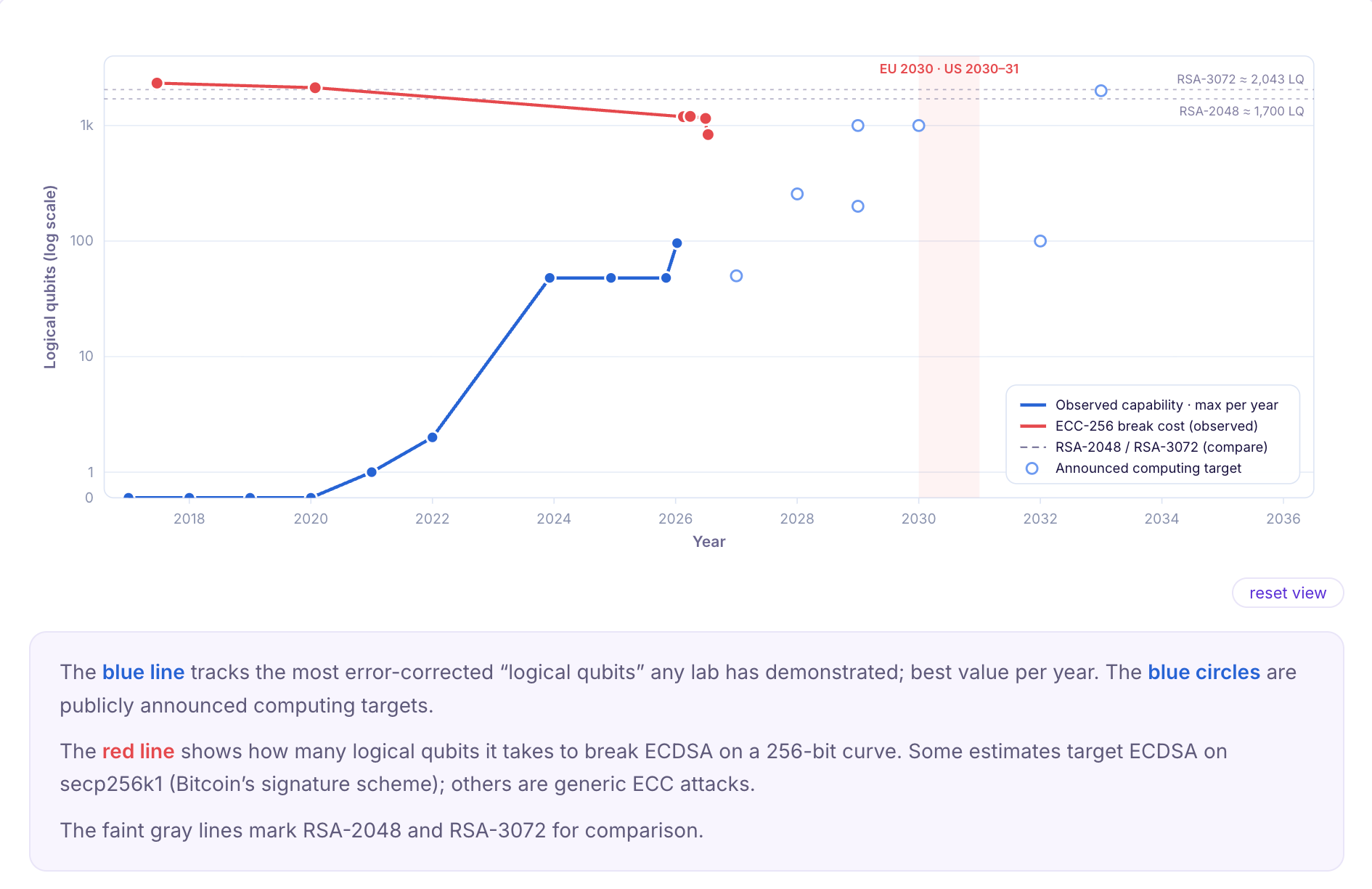
The pattern is unambiguous: the attack threshold for ECDSA has dropped 65% in under a decade. New academic results continue to push the number lower, and the ecdsa.fail AI competition slowly eats away at the gap.
Migrating an Entire Ecosystem
If ECDSA breaks, any address whose public key has been revealed onchain — which includes every address that has ever sent a transaction — is at risk. A sufficiently powerful quantum computer could derive the private key and drain the assets.
Account holders will need to migrate their digital assets. This requires a wallet infrastructure to support post-quantum signatures, meaning changes to libraries, cold storage, and even hardware. Wallets do not know which signatures to support until blockchains announce their transaction signature choices. Smaller chains may want to follow the industry trends to ensure tooling exists for their users.
The post-quantum migration requires updating an entire ecosystem all at once. Blockchains need to begin operating in hybrid mode: supporting both classical and post-quantum signature schemes in parallel, so holders have the runway to migrate before the window closes.
How Circle Is Preparing for Quantum Era
Circle is preparing for a post-quantum world.
Arc already supports SLH-DSA, one of NIST’s standardized post-quantum signature schemes. This gives developers and wallets a way to use post-quantum signatures on Arc today. At the same time, Arc has not selected a final post-quantum signature for signing transactions. Arc uses ECDSA for transaction signatures and will continue to support ECDSA in a hybrid mode after a final transaction signature scheme is selected - preserving optionality while the ecosystem matures.
Circle is deliberate about not locking in critical decisions prematurely and is actively evaluating quantum security across all of Arc, with the aim of ensuring Arc is designed to adapt as technology, standards, and risks evolve.
USDC operates across 30+ blockchains, so interoperability matters. Circle is in active dialogue with other blockchains and wallet providers to ensure Arc's approach is compatible with the broader ecosystem. Moving too late could leave users without enough time to prepare; moving too early risks performance tradeoffs or commitment to choices made before the standards are fully settled.
The Circle Quantum Tracker is part of Circle’s commitment to data-driven decisions. Every data point in the tracker links to its primary source - giving developers and security teams the information they need to understand what is changing, assess their exposure, and plan accordingly.
What Your Team Should Do Now
Developers should treat the quantum transition as any other infrastructure upgrade. Start with a cryptographic inventory. Identify vendor dependencies. Prepare to rotate keys. ECDSA will likely fail first, but harvest-now-decrypt-later attacks could eventually compromise every exposed key. Finally, smart contracts that use ecrecover or other ECC-based functions will likely need to update to post-quantum.
If your team is looking for a low-fee high-throughput blockchain with confidential transactions that are designed to supportpost-quantum security, you should build on Arc.
Explore the Circle Quantum Tracker
Every dot on the chart links to its source. Bookmark it, share it with your security team, and mind the gap.
Arc is an open L1 blockchain launched by Arc Network Services LLC ("Arc LLC") and operated by a permissioned validator set. Arc LLC provides software services only and does not offer regulated financial or advisory services. Arc has not been reviewed or approved by the New York State Department of Financial Services or any other regulatory authority.
The Arc network is provided "as is" and "as available." Use of Arc involves inherent risks associated with blockchain technology, including smart contract vulnerabilities, network disruptions, and the absence of recourse for transaction errors or losses. The ability to transact on Arc depends on the ability to obtain and use USDC to pay gas fees. Neither Arc LLC nor any permissioned validator is responsible for the content, accuracy, legality, or functionality of third-party applications, protocols, or services built on or integrated with Arc. You are solely responsible for features or services you provide to users, including obtaining any necessary licenses or approvals and otherwise complying with applicable laws.
All Arc features may be modified, delayed, or cancelled at any time without notice. Nothing herein constitutes a commitment, warranty, guarantee or legal, regulatory, tax, or investment advice. Coming soon.
Post-quantum cryptography remains an evolving area of research, standard-setting, and implementation. The features, design approaches, and roadmap items described here reflect Circle’s current thinking based on available standards, technical assumptions, and product plans, all of which may change over time. Quantum-related risks, timelines, and mitigation strategies are inherently uncertain, and no post-quantum design can eliminate all future security risk. This material is provided for informational purposes only and does not constitute a guarantee, warranty, or commitment regarding future performance, resilience, or availability.
* All data is compiled from public sources as of July 21, 2026. This tracker was developed by the Circle Research team for informational purposes only. It reflects the team's current understanding of developments as made available by publicly available third-party sources as of the dates indicated and is subject to change without notice. Made available on an AS IS and AS AVAILABLE basis. Nothing in this tracker constitutes legal, regulatory, tax, or financial advice, a commitment, or a warranty, and it should not be relied upon as such. The information contained herein may be incomplete, may not reflect the most recent developments, and has not been independently verified. Circle expressly disclaims any liability arising from reliance on the information contained herein.