Learn how HIFI enables developers to build seamless global stablecoin payouts using USDC, Cross Chain Transfer Protocol, and Circle Payments Network.
Learn how HIFI enables developers to build seamless cross-border payment flows using CCTP and Circle Payments Network.
Imagine a world where your USDC can move more efficiently across chains and reach payout partners globally, without manually bridging funds, juggling liquidity, while supporting compliance workflows. That’s exactly what HIFI and Circle are building together.
By integrating Circle Payments Network (CPN) and the native USDC bridging infrastructure provided by Circle CCTP, HIFI provides developers with a modular, designed-for-security, and programmable approach to money movement.
Real-world use cases
HIFI’s APIs bundled with Circle products enable developers to power a wide range of payment use cases with speed, flexibility, and global reach:
- Global payouts: Pay contractors, creators, or employees around the world.
- Treasury operations: Hold USDC on one chain and convert to fiat payouts wherever supported.
- Stablecoin payments: Accept USDC on supported chains and settle fiat with merchants around the world through a single interface, reducing manual workflows.
Bridging the gap between onchain liquidity and offchain payouts
Global stablecoin payouts and crosschain payments are still more complicated than they should be. Some of the main factors that contribute to this complication are:
- USDC exists across many chains, but payout partners (i.e., Beneficiary Financial Institutions, or BFIs) only support a subset. Developers are often forced to bridge manually, adding extra steps and operational risk.
- Adding a new payout corridor can take weeks of integration work, from compliance checks to local account setup and travel rule requirements.
- Multi-step workflows become fragile when they rely on multiple providers, with funds constantly moving in and out of different ecosystems.
CPN is designed to enable fast and efficient stablecoin payouts. The catch is that it currently supports only a handful of blockchains: Ethereum, Polygon, and Solana. These networks reflect where many payout partners operate today, enabling seamless integration with existing global payout infrastructure.
Meanwhile, users don’t think in terms of “supported chains.” They’re holding USDC on Base, Arbitrum, Optimism and beyond, and they expect to be able to cash out from wherever they are.
HIFI saw this gap as an opportunity to rethink money movement from a developer’s perspective.
HIFI’s modular approach
HIFI gives developers flexible options to either combine or separate the steps for bridging and offramping depending on their workflow:
1. Bridging only
Move USDC across chains securely using Circle’s bridging infrastructure — all within HIFI’s ecosystem and API interface. This is perfect for positioning funds ahead of payouts or other operations, without leaving the system.
curl -X POST https://production.hifi.com/v2/wallets/bridges \
  -H "Authorization: Bearer <API_KEY>" \
  -d '{
    "requestId": "unique-request-id",
    "amount": "7777.77",
    "source": { "currency": "usdc", "userId": "user_xxxxxxxxxxxx", "chain": "BASE" },
    "destination": { "currency": "usdc", "userId": "user_xxxxxxxxxxxx", "accountId": "cpn_xxxxxxxxxxxxxxxx", "chain": "ETHEREUM" }
  }'
2. Full payout in one request
Submit a single CPN payout request, and HIFI takes care of any required bridging plus payout settlement. Developers can focus on building their business logic and don’t have to worry about the overhead of moving liquidity around manually.
curl -X POST https://production.hifi.com/v2/offramps \
  -H "Authorization: Bearer <API_KEY>" \
  -d '{
    "requestId": "unique-request-id",
    "source": { "amount": "7777.77", "currency": "usdc", "userId": "user_xxxxxxxxxxxx", "chain": "BASE" },
    "destination": { "currency": "hkd", "userId": "user_xxxxxxxxxxxx", "accountId": "cpn_xxxxxxxxxxxxxxxx" }
  }'
3. Bridge then payout
Developers can move USDC to a supported target chain via HIFI’s bridging endpoint, then execute the payout through CPN. This workflow is ideal when additional business logic needs to run after liquidity reaches the destination chain, giving developers more control over the process. All bridging and payout operations remain inside HIFI, reducing operational risk and keeping everything within a single ecosystem.
Why CCTP matters in HIFI’s architecture
At the core of HIFI’s bridging capability is CCTP, which is purpose-built for moving native USDC across supported blockchains in a secure and predictable way.
Unlike traditional bridges, CCTP reduces the friction developers are used to dealing with when moving funds across chains. Some of the key advantages HIFI gleans by using CCTP over a traditional bridge are:
- With CCTP, USDC is burned on the source chain and minted on the destination chain. So if you send 100 USDC, you receive 100 USDC without having to worry about slippage.
- CCTP supports both EVM and non-EVM chains, making it easy to move funds across networks like Ethereum, Polygon, and Solana. Developers don’t have to think about where liquidity lives; they can just move it where it needs to be.
- CCTP can support fast transfers that can bring bridging times down from typical finality windows (e.g., ~12–15 minutes) to seconds in certain conditions. This is especially useful for time-sensitive flows, like locking in FX rates or executing payouts quickly.
- One of the most powerful parts of CCTP is what happens after the transfer. With support for post-transfer hooks, HIFI can trigger onchain actions as soon as funds arrive, whether that’s kicking off a payout or handling things like fee settlement automatically.
How it works under the hood
The diagram below breaks down how developers can route USDC across chains using CCTP and offramp to fiat through Circle Payments Network:
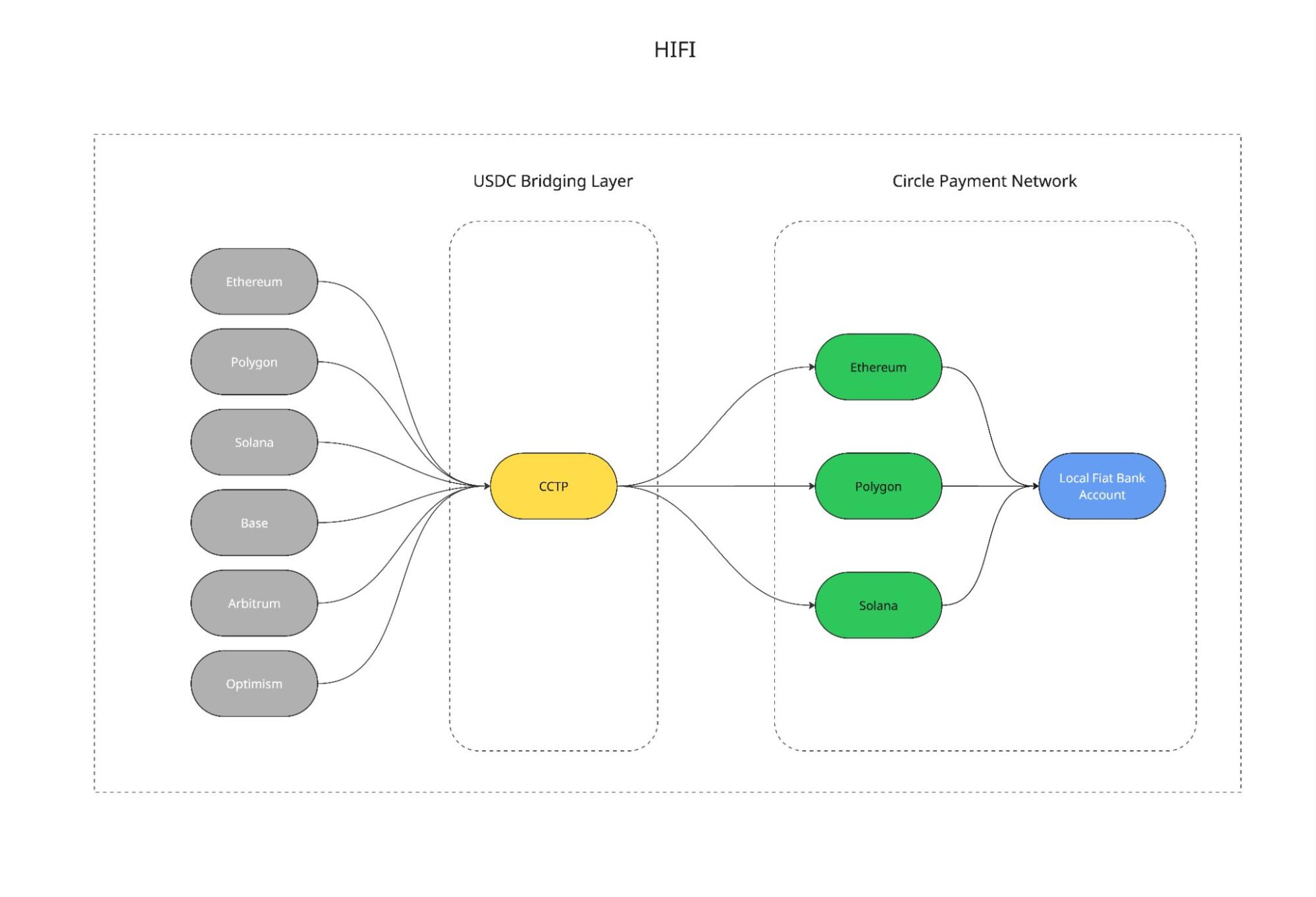
The process is simple, yet powerful:
- Determine fund location: When a payout request comes in, HIFI checks where the USDC currently resides and which chains the BFI supports on CPN.
- Bridge if needed: If funds need to move, HIFI leverages CCTP to securely transfer USDC to the chain supported by the BFI.
- Initiate payout via CPN: HIFI sends the USDC through CPN on the designated blockchain, including all necessary account information and travel rule data.
- Settlement and compliance: CPN takes care of cross-border payout settlement.
By handling bridging and payouts in a single platform, HIFI eliminates the hassle of integrating separate protocols or liquidity providers. This can help reduce payout delays, streamline operations, and minimize the risk of errors when moving funds across multiple platforms.
What this unlocks for developers and institutions
By combining Circle’s infrastructure with HIFI, developers and institutions can expand stablecoin payouts to chains like Base, Arbitrum, and Optimism without waiting for each BFI to support them. Developers can build modular and programmable payout workflows entirely within HIFI’s ecosystem. They can also activate new payout corridors quickly and avoid weeks of integration work and compliance overhead.
The result is a more scalable and flexible approach to cross chain stablecoin payouts within a single platform.
HIFI and Circle enable developers to move money globally and programmatically with confidence, whether bridging funds, orchestrating payouts, or operating within one unified system.
Developers can get started today by exploring the developer documentation.
USDC is issued by regulated affiliates of Circle. See Circle’s list of regulatory authorizations.
Circle Technology Services, LLC (CTS) is the operator of Circle Payments Network (CPN) and offers products and services to financial institutions that participate in CPN to facilitate their CPN access and integration. CPN connects participating financial institutions around the world, with CTS serving as the technology service provider to participating financial institutions. While CTS does not hold funds or manage accounts on behalf of customers, we enable the global ecosystem of participating financial institutions to connect directly with each other, communicate securely, and settle directly with each other. CTS is not a party to transactions between participating financial institutions facilitated by CPN who use CPN to execute transactions at their own risk. Use of CPN is subject to the CPN Rules and the CPN Participation Agreement between CTS and a participating financial institution.
Circle Technology Services, LLC ("CTS") is a software provider and does not provide regulated financial or advisory services. You are solely responsible for services you provide to users, including obtaining any necessary licenses or approvals and otherwise complying with applicable laws. For additional details, please see the Circle Developer terms of service, available at console.circle.com/legal/developer-terms.