
Circle leverages USDC in intercompany treasury management


When Treasury can move value with confidence at any hour, the organization gets more agile, not just at month-end but in day-to-day capital decisions.”

Treasury teams are increasingly expected to operate at the pace of global, always-on business. Yet money still runs on banking windows, hard cutoff times, and a choreography of interactions across banks, multinational organizations, and internal entities. To modernize intercompany transfer pricing and demonstrate what programmable money can unlock for modern treasury operations, Circle uses standard Circle Mint capabilities and USDC to replace traditional fiat wires, bringing stablecoin settlement into the regular monthly accounting process.
Circle’s implementation of USDC for intercompany transfers is an example that any eligible business can repeat without redesigning its treasury stack: integrate stablecoin settlement into a familiar accounting motion to reduce cash in transit, compress confirmation time, and improve monthly close execution, without compromising the controls treasury teams depend on.
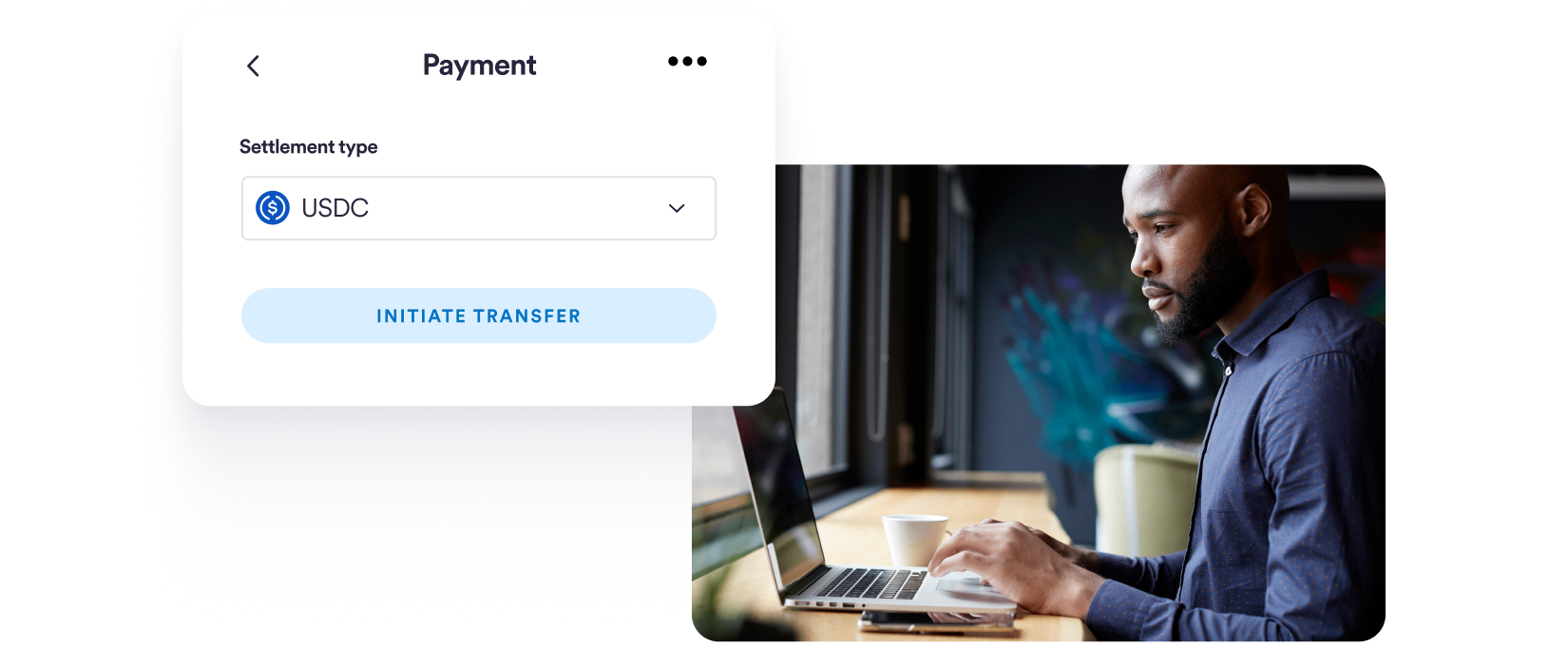
Cutoffs, delays, and cash in transit
Intercompany transfers rarely stop when they move from point A to point B. Rather, they often involve a chain of movements across multiple entities, and the whole sequence needs to settle with certainty and on schedule. Successful month-end close depends on workflow sequencing and timing, confirmation, and clean downstream accounting. Traditional fiat rails introduce friction and uncertainty in the moments when speed and precision matter most: cutoffs dictate when payments can be initiated, settlement confirmation arrives on a timeline that can slip past close schedules, and exceptions force operational teams into manual follow-ups. Treasury teams have done well to design systems and processes around these limitations, but these workarounds have become the work itself: buffers, handoffs, checks, and reconciliations that converge and intensify around month-end.
In practice, closing with traditional fiat rails creates the familiar “cash in transit” gap. Funds may be debited from one entity while the receiving entity cannot confidently treat them as available.
Month-end friction isn’t about effort – it’s about infrastructure. Traditional banking rails introduce timing uncertainty, forcing us to reconcile around ambiguity instead of closing on facts.”
While stablecoins are often associated with improving cross-border payments, much of the operational pain is not exclusively international: the core issue is the combination of cutoffs, settlement uncertainty, multi-entity interaction, and the downstream effort required to manage that uncertainty. Problems that can surface even within domestic flows. Problems that stablecoins are uniquely designed to solve.
24/7 USDC settlement inside existing controls
To alleviate this universal pain point, the Circle treasury team has integrated USDC settlement into the existing monthly accounting motion for settlement of intercompany transfer pricing using Mint in a workflow designed to feel familiar to treasury teams operating in a controls-first environment. This is a foundational use case for Mint: transfers are initiated by authorized operators and executed through established approval practices designed to preserve segregation of duties and maintain an auditable trail.
Operationally, Circle’s treasury teams use the Mint account just as they would a banking portal: balances are verified, transfers are initiated, approvals are applied, and receipt is confirmed, now with always-on confirmation instead of business-hour-bounded confirmation. Within Mint, treasury teams can set role-based permissions, enforce dual approval requirements, and monitor transactions in near real time.

The win isn’t just faster settlement. It’s faster settlement without weakening controls. With USDC in Mint, we keep segregation of duties, approvals, and auditability intact, while getting confirmation on a timeline that matches the business.”
Transaction-level reporting in Mint is designed to support reconciliation and downstream accounting, so stablecoin settlement can fit cleanly into close without adding new manual steps. Specifically, Mint reporting aligns to the ISO 20022 camt.053 end-of-day statement standard and includes bank-grade end-to-end IDs (e.g., payment/reference IDs) that let teams match on-chain/settlement events to internal ledgers and third-party accounting systems for reconciliation from initiation through posting.
Making USDC settlement viable at close cadence also required back-office readiness, not just the ability to move value. In parallel with adopting USDC for this workflow, Circle invested in accounting and reconciliation enablement, including improvements to transaction reporting and integration paths into third-party accounting software (including Oracle), so reporting and close workflows can mature from manual steps toward more programmatic operations.
As the workflow evolved, the question has shifted from “is this possible” to “can this scale operationally,” with an emphasis on multi-entity administration, reporting, and reconciliation at close cadence. As usage scales, multi-entity administration becomes the gating factor, not settlement.
Mint is built to support multi-entity operations across accounts and Circle’s own deployment has reinforced the importance of reducing operator overhead at close cadence. Circle has developed product enhancements intended to streamline multi-entity operations across Mint accounts, including reducing the operational burden of switching between accounts, simplifying internal transfers between Mint accounts, and supporting more programmatic accounting workflows through a transaction reporting API as integrations mature. These updates to Mint will be rolling out in March 2026.
Unlocking faster close and cash redeployment
Circle’s USDC-enabled treasury workflow demonstrates that always-on settlement can support real treasury throughput. In a single month, Circle Treasury reported moving more than $68 million in USDC-settled transactions in 11 flows across 8 entities in under 30 minutes, compared with a one-to-two-day settlement and clearance timeline typical in a fiat environment (and sometimes up to three days).
The practical implication isn’t only speed. It’s compression of the cash-in-transit window and a reduction in the operational drag that comes with it, including idle cash needed to pre-fund bank accounts. When confirmation shrinks from days to minutes, the workload tied to tracking, follow-ups, and uncertainty falls away. Treasury teams can act with greater confidence that balances reflect reality.

Close execution compressed as well. Circle completed approximately 90% of intercompany settlements related to transfer pricing activity in a single day, processing more than 26 manual transfer pricing movements. The execution window tightened from days to minutes. Tail risk from open items dropped concurrently. Completion timing during close became more consistent.
Even for domestic flows, always-on settlement reduced reliance on banking cutoffs and shortened time to close. As we expand this workflow to more global entities and currencies, these benefits are expected to only increase.
Circle’s USDC-enabled intercompany workflow shows that faster settlement isn’t just a payments upgrade. It’s an operating advantage on a daily basis and at month-end close. By shrinking confirmation from days to minutes, treasury reduces the cash-in-transit gap, eliminates much of the follow-up work that accumulates around exceptions, and gains higher confidence that reported balances reflect reality. With Mint’s permissions, approvals, audit trail, and reporting built in, stablecoin settlement can increase speed without weakening controls, freeing treasury teams to focus on forecasting, liquidity, and strategic cash deployment.
Discover how Circle can help your business
Sign up to receive all the latest news and updates from Circle.
Explore more stories
















Fully backed digital dollars
Built for rapid global payments and 24/7 financial markets, USDC is a regulated digital currency you can redeem 1:1 for US dollars.