

LuLu Financial Holdings settles GCC, MENA, and APAC remittances 24/7 with USDC


The emergence of stablecoins completely changed how we think about moving money. Rather than just fixing a transfer problem, we realized we could reinvent our entire settlement infrastructure.”

Around the world, people send money home at any time, but the dollars behind their transfers still move on bank time. For remittance providers that settle in US dollars, the mismatch is structural: value moves only while correspondent banks are open, and intermediaries along the chain add fees, FX drag, and delay.
LuLu Financial Holdings (LFH) has a direct view into this mismatch. Through a subsidiary, it operates a remittance-as-a-service provider, giving licensed financial institutions and fintechs the infrastructure to run cross-border payment applications without the cost and complexity of building their own.
But because that infrastructure serves the Gulf Cooperation Council (GCC), and the Middle East and North Africa (MENA), and Asia Pacific (APAC) regions, US dollar settlement depends on banking hours in multiple parts of the world. That adds friction, which can raise costs and slow transfers. Manual processing adds drag of its own.
We weren’t just dealing with technical delays. These gaps directly hit our settlement efficiency and our ability to move liquidity when it was needed most.”
In the background, LFH’s partners and customers increasingly expected digital-first payment experiences comparable to modern fintech platforms, and demand kept building for settlement faster than traditional banking timelines could deliver. USDC, a regulated¹, Circle-issued stablecoin designed to maintain stable value relative to the US dollar, offered a path through the mismatch.
Treasury movement that stopped waiting for the banking day
LFH was wary of moving away from the stability and global acceptance of the US dollar, with any alternative required to behave like dollars. USDC fit that constraint, keeping the familiarity of USD denomination while settling in near real time, independent of conventional banking operating windows. And for a team that needed security, regulatory alignment, and operational trust, Circle’s reputation as one of the earliest and most established stablecoin issuers was critical.
Now, US dollars are onramped into the company’s Circle Mint2 account and converted 1:1 into USDC. The minted USDC moves to partner wallets to fund cross-border settlement. Receiving partners hold it as working liquidity or redeem it into fiat through supported banking and payout rails. Because minting runs in near real time and USDC moves at any hour, the team can now move treasury funds and access liquidity around the clock instead of working around the banking day.

Lower costs, sub-minute finality, growing volume
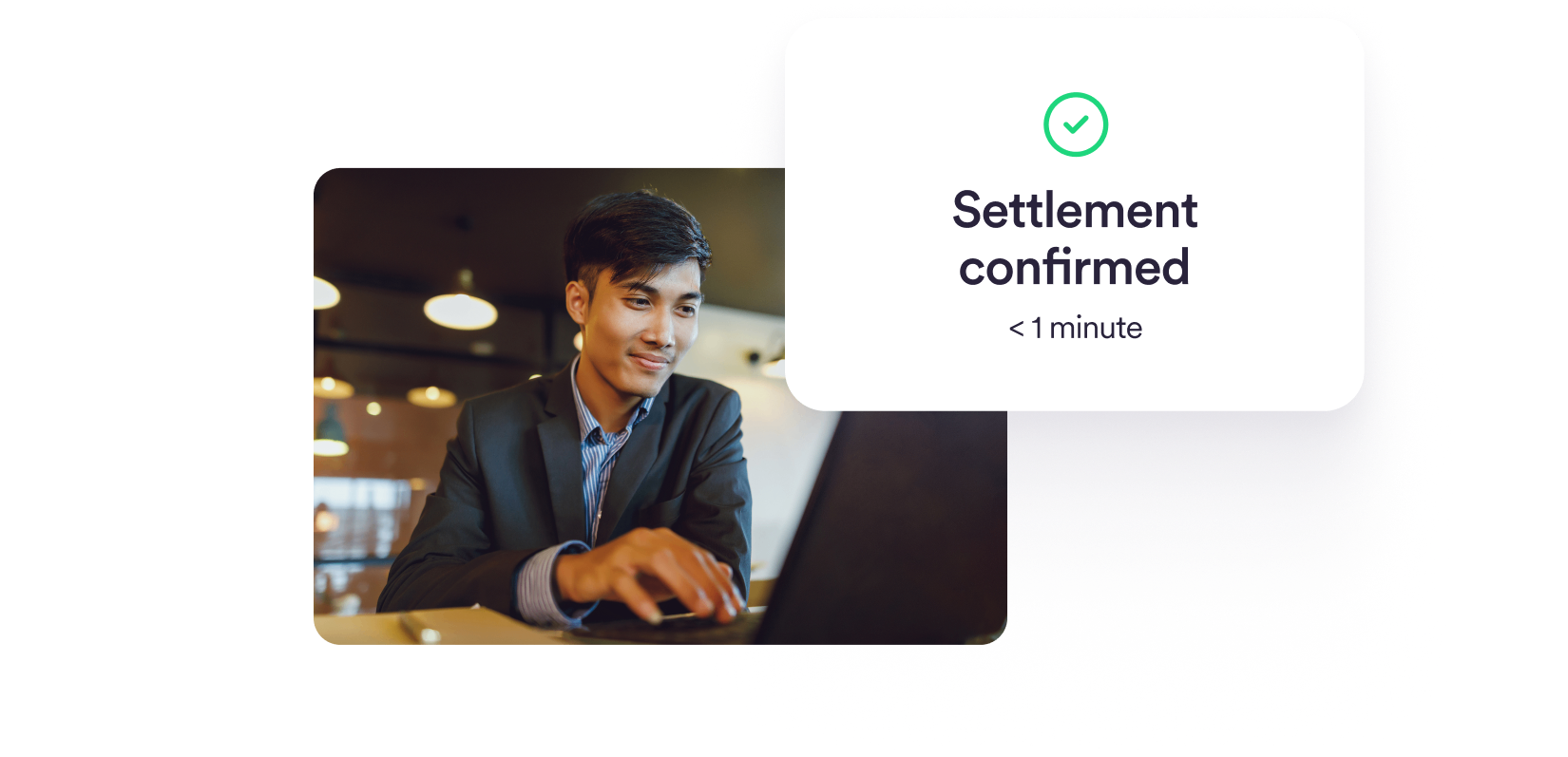
LFH reports a 25–30% reduction in cross-border settlement costs versus its prior correspondent banking channels, while settlement volume has grown 40% since the shift to USDC. Settlements now complete 24/7, with the recipient credited in under a minute.
Precision held up too. The company reports 100% settlement amount accuracy and a 100% conversion success rate across its onramp and offramp flows. Funds show up in its wallet as soon as they’re credited to its Circle account, while redemptions to fiat are credited during US business hours, where the account is held. And because settlements move onchain, treasury and operations teams can verify the status and amount of a transfer in real time — no tracing payments through a chain of correspondent intermediaries.
Day to day, settlements are more cost-efficient across partners and corridors, and the stack has consolidated: wallets, settlement flows, and blockchain operations that once spanned multiple providers are simpler to manage. The embrace of USDC and Circle Wallets3— secure wallet infrastructure for blockchain use cases — also opens new commercial doors in the form of work with liquidity providers, broader payout reach through partners that support USDC settlement, and a stronger footing in emerging stablecoin-powered payment corridors.
Deeper into programmable settlement
Looking ahead, the roadmap points further into Circle’s ecosystem. LFH is evaluating broader use of Circle’s custodial wallets inside its own products and may add support for Circle’s CCTP, which moves USDC natively across blockchains.
Circle has enabled us to deliver a level of settlement speed, liquidity flexibility, and operational transparency that would have been difficult to achieve through traditional settlement infrastructure alone.”
The blueprint for global remittance providers is concrete: keep the regulated entity, keep the local payout relationships, and let a digital dollar treasury move value between them at any hour of any day. LFH runs that model in production now.
Note: Circle has a commercial relationship with LuLu Money Singapore
¹ USDC is issued by regulated affiliates of Circle. A list of Circle’s regulatory authorizations can be found here https://www.circle.com/legal/licenses
² Circle Mint is provided by Circle Internet Singapore Pte Ltd who is licensed to provide these services as a holder of Major Payment institution license from the Monetary Authority of Singapore. Circle is not a bank; Circle Mint is not a bank account, and any funds are not insured by any government agency, insurance fund, person or entity. ©Circle Internet Group, Inc. All rights reserved. One World Trade Center, 87th Floor, New York, NY 10007, United States
3Circle Wallets are provided by Circle Technology Services, LLC (“CTS”). CTS is a software provider and does not provide regulated financial or advisory services. You are solely responsible for services you provide to users, including obtaining any necessary licenses or approvals and otherwise complying with applicable laws. For additional details, refer to the Circle Developer Terms of Service.
Descubra cómo Circle puede ayudar a su empresa
Suscríbase para recibir las últimas noticias y actualizaciones de Circle.
Explore más historias
















Dólares digitales totalmente respaldados
Creado para pagos globales rápidos y mercados financieros ininterrumpidos, USDC es una moneda digital regulada canjeable 1:1 por dólares estadounidenses.