Solvers often struggle to allocate capital across blockchains efficiently, with some losing up to half their profit potential due to sub-optimal allocations. Gateway addresses this inefficiency by enabling just-in-time capital deployment, resulting in greater capital efficiency and increased profitability.

Businesses holding USDC balances across blockchains face a familiar trade-off. They are forced to pre-position their capital across multiple chains in order to facilitate user demand. Their profitability is directly impacted by their ability to accurately forecast user activity in advance and deploy their capital in the most efficient and responsive way, especially as dynamic market conditions often change rapidly.
While this trade-off applies to any business holding multichain capital, such as onramps, PSPs, exchanges, and custodians, this particular issue is extremely acute for crosschain solvers (“solvers”). These solvers facilitate user bridging demand, otherwise known as “intents.” Most solvers maintain relatively fixed allocations across chains, often leading to overfunding, while others actively rebalance to take advantage of sudden demand spikes, but are constrained by source blockchain finality times. In practice, most adopt a hybrid approach between fixed allocations and active rebalancing; but whatever the mix, profitability is ultimately limited by how and where capital is allocated.
These tradeoffs result in inefficient capital utilization. In practice, every dollar of USDC overfunded across multiple blockchains is capital that could instead be used to fill profitable order flow elsewhere, which is a direct opportunity cost for solvers trying to stay competitive. Based on our conversations with solvers, up to 50% of potential profitability can be lost to inefficient allocation across chains. Despite frequent rebalancing, unpredictable market conditions and slow crosschain settlement times make it nearly impossible to forecast liquidity demand accurately.
Solving with Gateway
Circle Gateway changes this equation. After solvers deposit their USDC into Gateway, their chain-specific balances morph into a single, chain-abstracted balance that can be deployed any time at next-block speeds across supported chains. This model fundamentally redefines the speed of crosschain operations. With Gateway, solvers can now allocate capital just-in-time to capture the best order flow opportunities as they arise, rather than relying on accurately pre-positioning liquidity across chains based on their demand forecasts.
The Gateway advantage comes from the fact that any crosschain transfer must first be verified by the source chain’s consensus mechanism. Depending on the chain, that finality process can take anywhere from seconds to up to 20 minutes. Gateway doesn’t eliminate that latency, but it minimizes the impact on how a solver deploys capital, by allowing them to strategically front-load the finality wait time before the capital is needed. Other crosschain services (i.e. bridges) require the source chain transaction to finalize before liquidity can be provided on the destination chain, resulting in unavoidable latency for each transfer. By front-loading finality, Gateway enables instant crosschain capital deployment wherever and whenever it's needed on supported chains.
Modeling Capital Efficiency and Profitability with Gateway
How valuable is this crosschain flexibility? Using a new mathematical model proposed in Bennett (2025) from Circle Research, we can approximate this situation by evaluating a crosschain service with negligible allocation time. Gateway's sub-500ms crosschain transfer speeds makes it the fastest crosschain service in comparison, enabling effectively instant allocation time. With Gateway, latency no longer constrains profit opportunities, leaving only capital constraints and cost considerations. Under this model, a solver leveraging Gateway can access every available order flow opportunity across supported chains at a given level of capital up to $1M, resulting in equal or higher profitability with finite capital compared to pre-allocating capital to anticipate demand.
Consider a sample solver’s strategy below leveraging Gateway:
Context: Assume that a solver only has 100 USDC available and chooses to deposit this in Gateway, rather than holding 50 USDC each on two separate chains. Furthermore, assume they allocate capital across two chains – Chain A and Chain B – and each chain has requests for 25 and 75 USDC that require instant settlement.
Strategy: Looking at the solver’s options, we see that without Gateway the solver can only fulfill one combination of orders: the 25 USDC order on each chain. With Gateway, however, they can fill five different combinations of orders. If they select the most profitable one from this group, they could obtain a more profitable allocation.
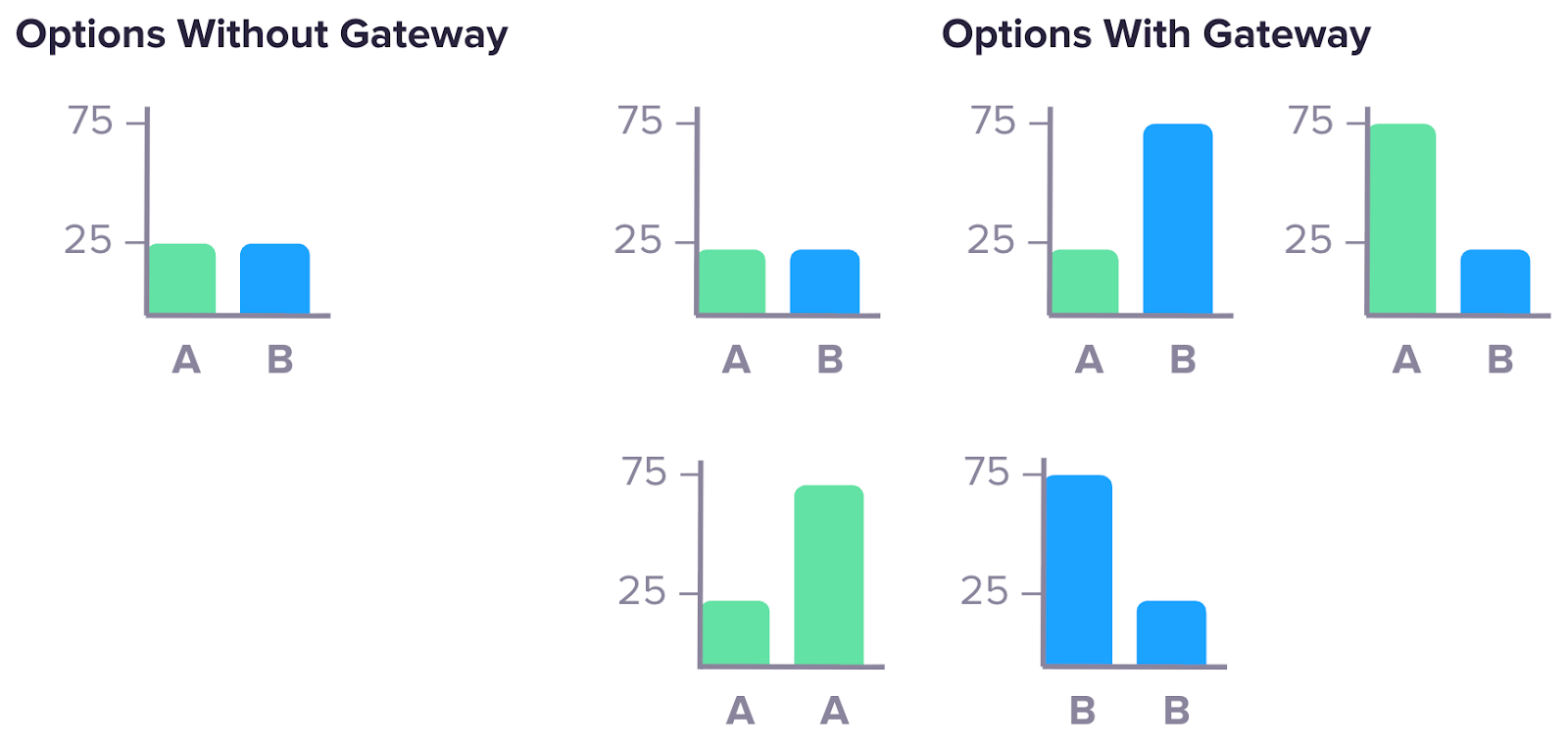
Results: The solver accesses the most profitable opportunities for a given level of capital due to just-in-time capital deployment. While the above is a simple example to illustrate the concept, this effect becomes much more pronounced as the number of chains increases since each new chain launched drives even more liquidity fragmentation.
Now, let’s compare this to a solver’s strategy of pre-funding across chains and rebalancing using bridges at a potentially lower cost. Due to source chain finality latency for every crosschain transfer, by the time funds reach a destination chain, the most profitable opportunities may have disappeared. Solvers using this strategy must therefore weigh additional capital costs from overfunding against the opportunity cost of missed opportunities or slippage.
This comparison makes speed a decisive variable. As a result, Gateway can still produce net capital efficiency gains even if it’s more expensive to use than slower alternatives. Bennett (2025) describes this general tradeoff as a balance between speed and cost, which we can apply to this case.
At a high level, for a capital-constrained solver, if the additional profit potential from using Gateway exceeds a fixed protocol fee, then a decision to allocate some portion of the solver’s capital will deliver a mathematically provable capital efficiency gain. This is because the optimal use of Gateway may not require deploying all available capital, but just enough to capture more unpredictable and lucrative opportunities.
The simplified example pictured below illustrates this relationship:
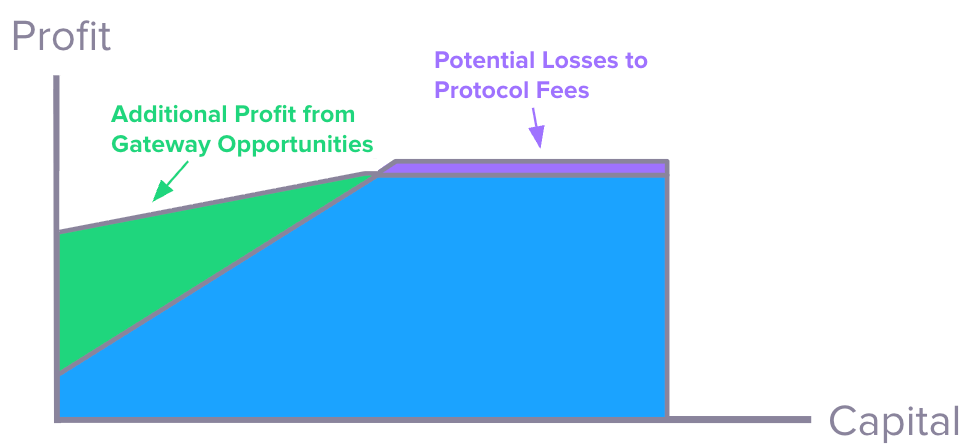
For capital-constrained solvers, the benefits of utilizing Gateway will come down to the amount of capital they hold relative to the available opportunities. On one end, if the solver is not capital constrained at all, Gateway will demonstrate little added value, since pre-positioning would capture all activity. As the amount of capital held decreases relative to the available opportunities, however, the flexibility and efficiency of Gateway will drive additional gains.
The best part is that solvers can employ both strategies, using Gateway for just-in-time, variable opportunities while employing other cost-effective rebalancing strategies for more predictable opportunities.
Real World Impact
These benefits are not just theoretical, they are being proven out by Gateway users today. For example, RockawayX leverages Gateway for this exact hybrid strategy. RockawayX keeps fixed balances on a few chains for predictable order flow opportunities, but fills larger order flow opportunities on supported chains using their chain-abstracted USDC balance within Gateway. While these larger orders are infrequent on any given chain, collectively they represent a steady stream of high-value profit opportunities unlocked by Gateway.
“Gateway allows us to capture opportunities that we couldn't before. For example, we can now fill orders up to $1M on any of the Gateway supported chains, while this would have been completely infeasible in the past. This improves the service we can offer as well as capturing additional fee revenue.” - Tomas Livora at RockawayX
RockawayX also deploys their available chain-abstracted USDC in Gateway to supported chains instantly as a backstop any time a variable order flow opportunity arises, in which their pre-funded balance isn’t sufficient to fill the demand spike. One example they gave was to win a 500,000 USDC order, they could use 100,000 USDC of their pre-funded capital on Polygon and dispense 400,000 USDC instantly from their chain-abstracted balance held in Gateway to capture the order flow opportunity.
By employing this combined strategy, they no longer have to rely on accurate demand forecasting across chains, achieving optimal capital utilization. As Gateway continues to expand to new blockchains, these capital efficiency gains will only increase; ushering in a new era of crosschain operations.
Get Started with Gateway
Circle Gateway is available on 11 supported chains and permissionless to integrate. Explore our developer docs to get started.