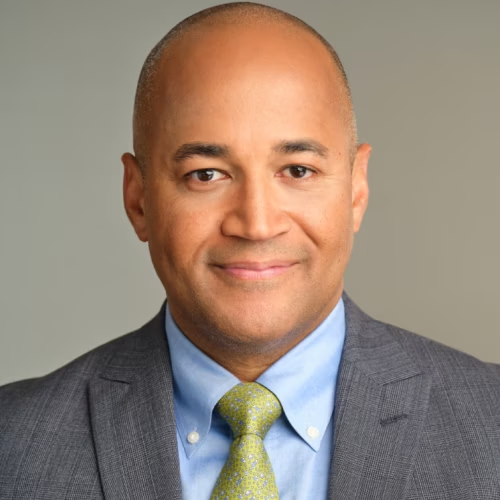
Dante Disparte provides evidence to the UK House of Lords on the future of stablecoin regulation, emphasizing the UK’s opportunity to lead with a robust, principles-based financial framework.
Today, Circle’s Chief Strategy Officer and Head of Global Policy and Operations, Dante Disparte, appeared before the House of Lords Financial Services Regulation Committee as part of its inquiry into the Growth and Proposed Regulation of Stablecoins in the UK. The session offered a critical opportunity to discuss how the UK can establish a world-leading, principles-based framework for digital assets that balances innovation with financial stability.
Opening Remarks
The UK stands at a familiar crossroads: whether to lead with clear principles and shape the digital economy according to British standards, or to follow - importing rules later at greater cost to sovereignty and competitiveness. You cannot have the economy of the future, without the money of the future, and you cannot put new money on old rails.
Stablecoins are moving from the fringe of finance to the core. They are already used for trillions in settlement, cross-border payments, treasury operations, and as the digital tender of an emerging AI-powered economy. The question is not whether they will exist - but where they will be supervised, which currencies they will reference, and which rulebook will prevail.
The UK has an opportunity to design a regime that is both more principled than Europe’s MiCA and more aligned with the emerging direction of the United States - without copying either. The model is clear: take the best of both and make it distinctly British.
From Europe, take clarity - definitions, licensing, governance, and strong consumer protection. From the U.S. and the landmark GENIUS ACT, take the core stablecoin doctrine: fully reserved, redeemable at par, and subject to robust supervision. Then add the UK’s strength: technology-neutral, outcomes-based regulation designed for international harmonisation.
That is the prize: a regime that attracts responsible stablecoin issuers, supports banks, strengthens economic ties, and reinforces London’s role as a major financial center in a digitising global economy.
Let me address the concerns raised thus far in these hearings - because they are not reasons to avoid regulation, but to do it well.
First: “The UK payments system already works - why change it?”
Because the UK economy is not just domestic retail payments. It is global markets, trade, and cross-border commerce - where systems remain slow, costly, and fragmented. Stablecoins can reduce friction where it still exists: cross-border settlement, 24/7 money movement, and programmable payments where compliance and delivery become built-in features.
This is not about replacing Faster Payments. It is about ensuring the UK remains competitive in a world where value must move as seamlessly as information.
Second: “Stablecoins will drain deposits and reduce credit.”
The future is not banks versus stablecoins. It is a multi-money system, as Sarah Breeden at the Bank of England has called for, where each serves a role - under clear rules.
A well-designed UK framework can manage risks without stifling innovation: strong reserve and liquidity standards, and a structure that encourages bank participation - as custodians, distributors, and critical links to the real economy.
As the digital economy grows, so too will regulated financial intermediation. Our growth across currencies and jurisdictions is proof that trusted stablecoins expand markets - they do not shrink them.
Third: “Stablecoins are a run risk.”
Any form of money can face a run or loss of confidence if poorly designed. The answer is not avoidance, but discipline. Four principles should anchor the UK approach: one-to-one backing, high-quality liquid reserves, fast and enforceable redemption at par, and strong transparency under supervision.
These are simply core tenets of issuing a trusted, widely used and regulated stablecoin.
Fourth: “Stablecoins enable illicit finance.”
Effective deterrence of illicit finance is a feature of every payment system. The question is whether the system is supervisable, auditable, and enforceable. Done properly, stablecoins can increase visibility: public blockchains—combined with regulated on- and off-ramps, screening, monitoring, and clear obligations—can provide continuous, data-driven oversight giving bad actors few places to hide.
The answer is not to lose the principle of technology-neutrality; it is to promote controls, accountability, and cybersecurity, from the issuer, the blockchain networks, to the retail wallet providers – all in line with global law enforcement and financial privacy norms.
Finally, why Circle’s experience matters.
We are not asking the UK to take a leap of faith. We are describing what already operates around the world under stringent regulatory standards. Circle is a world leader in tokenized digital money, and the open infrastructure that makes it move at internet-scale, with more than $70 trillion in cumulative transactions.
This is what responsible innovation looks like: resilience, transparency, and compliance by design.
The UK now faces a choice: create a clear and credible framework that attracts responsible actors - or allow activity to remain offshore, potentially importing risk without oversight or economic benefit.
My Lords, Ladies, the UK has led before by setting standards others chose to follow - not because they were the easiest, but because they were the most credible.
This is another such moment.
A principled UK stablecoin framework can strengthen financial stability, enhance competitiveness, support banks, and safeguard monetary sovereignty - while enabling much needed rules-based competition.
That opportunity is within reach and I look forward to the Committee's questions.