Explore how Circle and Kyriba are bringing USDC and AI into enterprise treasury to enable always-on settlement, liquidity visibility, and automation.
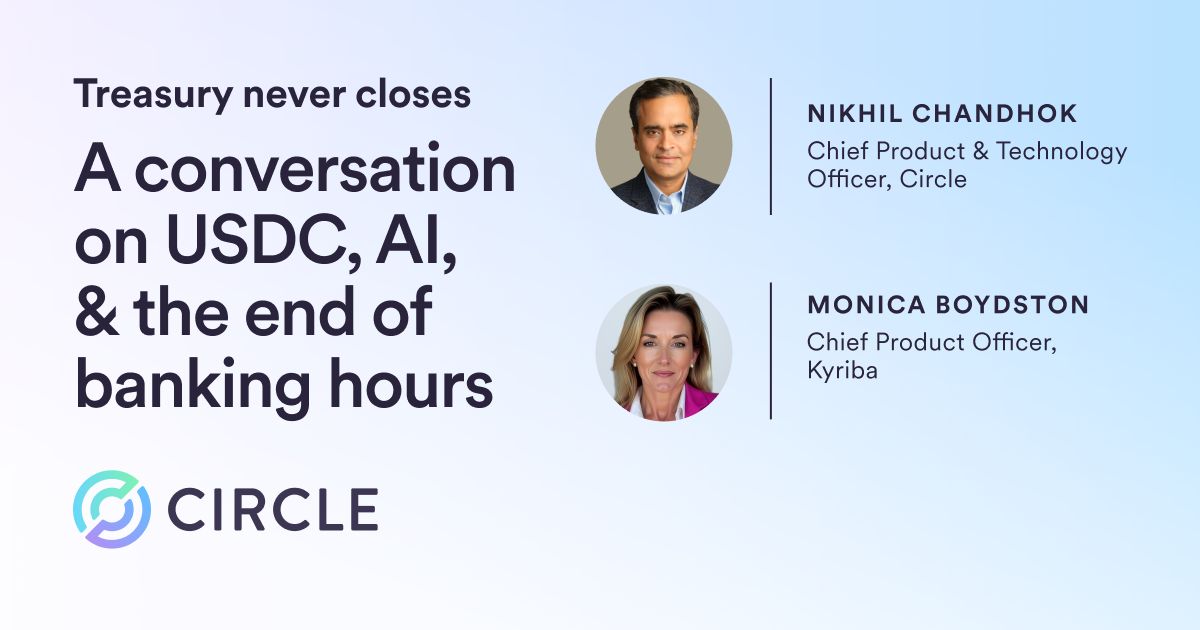
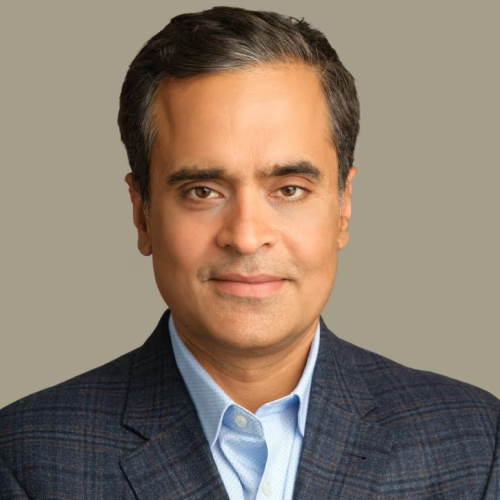
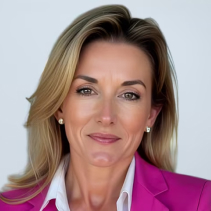
What would treasury look like if the rails never closed? Monica Boydston, Chief Product Officer at Kyriba, and Nikhil Chandhok, Chief Product and Technology Officer at Circle, discuss what it means to bring a regulated payment stablecoin natively into an enterprise treasury platform, and why the time is now. In this conversation, they explore the new reality of USDC treasury management, stablecoin TMS integration, and stablecoin settlement for enterprise finance teams.
Monica: Every treasury professional has lived this moment. Friday, 5:30pm. An overseas supplier needs payment to clear before a weekend deadline, and the answer is the same one it has been for decades: you are out of luck. Banks are closed. Nothing moves until Monday.
Finance leaders describe variations of that scenario in almost every conversation I have with them. What they are describing is not an exception. It is the baseline operating reality of global treasury.
Corporations have built entire planning disciplines around the gaps and delays in traditional banking rails, holding excess liquidity as an insurance policy against settlement uncertainty. Kyriba exists to eliminate exactly that kind of structural friction. Our partnership with Circle, enabling USDC treasury management natively inside Kyriba, is the next concrete step. We are the first TMS provider to integrate USDC natively into an enterprise treasury platform, and the timing is deliberate. The goal is always-on global treasury.
Nikhil: The problem you describe is a challenge the market has been ready to solve for a while. Stablecoins have been talked about as a potential solution for years, but two things held back enterprise adoption. The first was operational: there was no way to use them inside the tools and workflows treasury teams already depend on. You couldn't just hand a treasurer a crypto wallet and call it a solution. The second was regulatory: CFOs and their legal teams needed clarity that a USDC was real, regulated money, and not an experiment.
Both of those conditions have now changed. Regulatory frameworks in the EU, the US, and many other markets have established that stablecoins are money. And now, with USDC natively integrated into Kyriba, the operational piece is answered too. Enterprise adoption of stablecoin payment rails finally has both conditions met.1
Monica: Finance teams are not looking for a new platform. They are not looking to learn a new system. The question I hear consistently from treasurers is direct: can I use USDC inside Kyriba? Not adjacent to it. Inside it. That question shaped every design decision we made.
USDC surfaces inside the same environment where treasury teams already manage cash positions, banking relationships, and approval workflows. Settlement is visible. Controls apply. The audit trail is complete.
Finance teams can initiate stablecoin payments for cross-border flows and intercompany settlements with the same governance and visibility they expect from any other transaction on the platform. The integration is native because stablecoin execution inside existing treasury workflows was always the design requirement, not a feature to be added later.
When treasury teams come to us in evaluation mode, the questions are consistent. Does the integration connect to existing bank accounts? Can our ERP feed into it? What does the approval workflow look like? And critically: what does a pilot look like before we go live? Those are the right questions, and every one of them has a concrete answer inside Kyriba.
Nikhil: That question, whether the operational path is actually available inside the tools finance teams already use, is the one Circle hears most often from enterprise customers moving toward stablecoin adoption. They don't need to be convinced that USDC settles in seconds, 24 hours a day, seven days a week. They can see that. What they need to know is whether they can plug it into their existing systems, governance structures, and reporting requirements without building an entirely new stack. The answer, through this integration, is yes. That's what changes the adoption calculus.
From Circle's perspective, what we observe in enterprise evaluation cycles is that legal and compliance teams move faster than most expect once the regulatory question is answered. The approval process that used to take months now compresses significantly when a team can point to a recognized regulatory framework and a stablecoin TMS integration that already meets their governance requirements.
The blockers are gone. What remains is a planning question, not a permission question.
Monica: Let me be specific about what changes. International payments today are opaque. A wire sent through a correspondent banking network can take days to settle, with limited visibility into where funds are at any given moment. Treasurers cannot easily measure counterparty exposure. They cannot see every intermediary in the chain.
With USDC on Kyriba, stablecoin settlement is direct. There are no correspondent banks. Movement is visible at every step, and receipt can be confirmed in seconds rather than days. A treasurer can see exactly what moved, when it moved, and who authorized it.
The transparency improvement changes how finance teams manage risk. Speed is almost secondary once you understand what full, real-time visibility means for a CFO who needs to certify a cash position.
Nikhil: That certification question matters more than most treasury teams initially realize. Enterprise teams have spent years reconciling positions after the fact. Real-time confirmation changes the workflow, not just the settlement window.
Monica: And that visibility extends beyond individual payments. When settlement is real-time, cash position data stays current continuously. Kyriba's intelligence layer can update liquidity forecasts against live data rather than running a weekly batch process.
Cash flow forecasting accuracy improves fundamentally. That matters most in the moments when it matters most: not on a Friday when positions are reconciled, but on a Tuesday morning when a decision cannot wait.
Nikhil: There's a capital efficiency dimension to stablecoin settlement that I think is underappreciated. Most global businesses that operate across multiple currencies have to hold local currency floats in each market against the uncertainty of when funds will actually clear through the correspondent network. That's trapped capital. It's not earning yield, it's not deployed strategically, it's sitting there as an insurance policy against slow rails.
When you can move dollars globally in seconds, at any hour, that buffer requirement compresses significantly. You can keep more of your working capital in dollars, deploy it where it's needed when it's needed, and eliminate a lot of the idle float that traditional treasury infrastructure requires. That's a structural improvement in how businesses manage liquidity.
And that capital efficiency gain compounds at scale. A business running treasury operations across 30 entities in 15 currencies, managing hundreds of intercompany flows per week, faces a coordination problem that traditional rails and manual processes simply cannot solve efficiently.
USDC infrastructure handles that transaction volume continuously, without the bottlenecks that come from banking hours, correspondent chains, or manual intervention at each step. Multi-entity, multi-currency operations are exactly where straight-through processing becomes a competitive necessity rather than a convenience.
Monica: The settlement rail is the foundation. The intelligence layer is what makes it actionable around the clock.
USDC settles 24 hours a day, seven days a week. The decisions governing when to use it, how much to move, and what risk thresholds to enforce need to operate with the same continuity. TAI, Kyriba's agentic AI solution, is built for exactly that purpose. Trained on more than twenty years of proprietary liquidity data, TAI monitors cash positions, anticipates shortfalls, flags FX exposures, and executes within the policy parameters the treasurer defines in advance.
Agentic AI differs from a chat assistant or a reporting tool in a fundamental way: it does not wait to be asked. It observes conditions, forms a goal, selects from available actions, and executes, then monitors outcomes and adjusts.
In a treasury context, that means TAI can identify a cash shortfall forming in a subsidiary, calculate the optimal funding source, initiate a transfer within policy parameters, and confirm settlement, without waiting for a human to notice the gap first. That is AI orchestration applied to real treasury operations, running continuously.
Nikhil: Enterprise customers hear that description and their minds go directly to governance. Can they set the right boundaries? Can they defend those parameters to a board, an auditor, or a regulator? That is the conversation Circle has most often with customers evaluating agentic AI.
Monica: The governance architecture is concrete. A treasurer might set a policy that says: execute intercompany sweeps up to $500K automatically, flag any FX exposure above 2% of monthly revenue for human review, and escalate any counterparty anomaly to a named approver before action is taken.
TAI operates within those approval workflows and policy thresholds at 3am on a Sunday exactly as it would at 9am on a Tuesday. The human-in-the-loop is always present, not as a bottleneck, but as the authority that defines what the system is permitted to do. The audit trail is complete. Escalation rules are enforced.
The treasurer is always in control.
Nikhil: The teams moving fastest on agentic AI adoption, in our experience at Circle, are not always the largest. Governance readiness matters more than scale. A team that has already mapped its approval workflows, defined its policy thresholds, and built its escalation logic can deploy this capability quickly, regardless of how many entities they operate. The framing you're describing is exactly what makes that possible: policy-bounded, human-in-the-loop, operating within governance structures the treasury team defines. It's not AI replacing judgment. It's AI extending the reach of judgment to every time zone, every hour of the week.
There's an important distinction worth drawing between AI that assists and AI that acts. A lot of what has been marketed to treasury teams is AI that surfaces information or generates a report. Agentic AI acts on what it finds. It takes a defined action to address the problem, within boundaries your team controls.
That's the difference. Not a smarter dashboard. A system that actually closes the loop.
Monica: The intelligence is only as trustworthy as the data behind it. We built TAI on Kyriba's own embedded model, trained on proprietary liquidity data. Sensitive treasury data does not pass through external infrastructure. For enterprise customers evaluating how to govern AI in finance, that distinction carries real weight.
The model understands what normal looks like inside a corporate treasury: seasonal cash patterns, entity-level behaviors, counterparty norms, intercompany flow structures. That contextual specificity is what separates actionable intelligence from generic AI output. A model that understands your treasury is a fundamentally different instrument than one that understands treasury in the abstract.
One of the most immediate places customers see this value is in cash flow forecasting. Because TAI is trained on years of entity-level data, it recognizes seasonal patterns, recurring flows, and structural behaviors specific to that business.
The result is a continuously refreshed multi-entity liquidity forecast, not a static snapshot run on Friday, but a live model that updates as conditions change. Forecast accuracy improves because the underlying model is specific, not generic. That is the difference between a number a treasury team is confident in and one they hedge.
Nikhil: From Circle's side, what's notable about this integration is that it represents the first time a regulated payment stablecoin has been natively embedded in a treasury management system at this level. That's a market first.
And it points to where enterprise finance is heading more broadly: treasury infrastructure that runs continuously, connects to global rails that don't observe banking hours, and applies AI to improve the quality of decisions made within it. The combination of USDC's settlement architecture and Kyriba's intelligence layer is a concrete example of what that direction looks like in practice.
Monica: Finance leaders I talk to fall into two clear groups. The first already holds USDC and needs to manage it inside a treasury management system with the same controls applied to every other asset. The second wants access to USDC and needs to understand how to operationalize it safely within existing governance frameworks.
Both groups are asking the same question: can I use USDC inside Kyriba? That question drove the integration. Businesses that operate globally, run on dollars, and care about liquidity efficiency do not want to exit their treasury platform to access a new settlement rail. They want the capability built in, governed, and auditable from day one. The answer is yes.
Nikhil: "Governed from day one" is the phrase that moves legal and compliance teams from cautious to confident. A capability inside the system they already trust, subject to the controls they already enforce, is a very different conversation from a separate pilot they have to manage and justify.
Monica: At scale, the case becomes even more direct. A treasury team managing 40 entities across multiple regions, running hundreds of payment flows per week, cannot absorb meaningful new capability without full automation and integration. That is the bar.
TAI and USDC together mean that treasury operations can grow in complexity without growing proportionally in headcount or manual effort. The automation and scale story is the one that resonates most with our largest customers, because they feel the constraint most acutely.
Nikhil: And the timing is right in a way it simply wasn't before. Regulatory clarity in the US and Europe means that finance teams can evaluate USDC as a treasury instrument. It is a recognized form of regulated digital cash. That changes how legal and compliance teams engage with it, how boards think about it, and how quickly a treasurer can get internal approval to use it.
The infrastructure and regulation are ready. What Kyriba has done is make the operational path available at the exact moment the institutional window is opening.
Monica: The vision is a treasury that never closes. Liquidity visible globally. Payments settling when they need to settle, regardless of the hour or the calendar. Intelligence running continuously, within human-defined policy bounds, with full auditability at every step. That is always-on treasury, and the infrastructure to build it exists today.
Always-on treasury refers to a treasury operating model in which payments, settlement, liquidity visibility, and AI-driven decision execution run continuously, unconstrained by banking hours, time zones, or manual intervention. It is the operating model that becomes possible when the settlement rail, the intelligence layer, and the governance framework are all built into the same platform.
For treasury teams ready to explore what the integration means in practice, whether you are managing existing digital assets, evaluating USDC for the first time, or asking whether TAI is the right fit for your organization, the path forward is clearer than it has ever been. The capability is available now, inside the platform you already use.
Always-on treasury is no longer a roadmap item. It is a decision.
Kyriba's USDC integration, powered by Circle, is available now on the Kyriba Liquidity Performance Platform. TAI, Kyriba's Trusted Agentic AI, is in active use by enterprise customers globally.
1. USDC is issued by regulated affiliates of Circle. See Circle’s list of regulatory authorizations here.