EURC surpasses €400 million in circulation, expanding euro stablecoin liquidity across major chains, exchanges, and payments under MiCA. Learn more about this milestone.
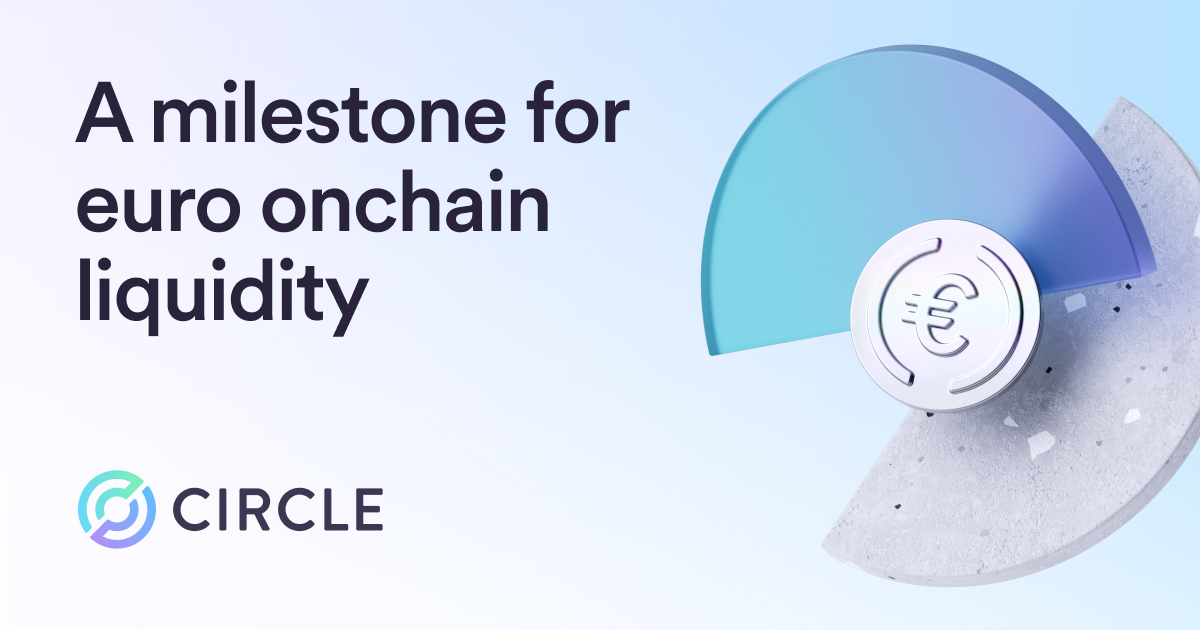
Today, money moves faster than ever before, especially with stablecoins — digital assets designed to maintain stable value against, in most cases, a backing asset. Over roughly the past decade, stablecoins backed by US dollars (and equivalents) have taken center stage among other fiat-pegged stablecoins, benefiting from more liquidity, transaction volume, and opportunities for stress testing. Stablecoins pegged to other local currencies, like euros, in comparison have broadly experienced a slower adoption curve and shallower liquidity.
For years, users looking to transact in euro-pegged stablecoins often had to use dollar stablecoins to on/offramp or as intermediary assets when trading, accept shallower euro-denominated onchain liquidity, or rely on bridges that weren’t built for long-term trust. What’s been missing for institutions, enterprises, and builders are euro-pegged digital assets that people can actually use day to day: easy to access, widely supported, and consistently redeemable at par.
That’s what EURC is built to be. And it’s why EURC has now surpassed €400 million in circulation, a milestone for euro liquidity in the onchain economy.
Over the past year, EURC’s supply increased by more than 100%, as the market moved from experimentation to real usage across exchanges, payment flows, and institutional workflows that demand reliability and compliance. EURC is now the most widely distributed and widely used euro stablecoin, supported across major blockchains, exchanges, and payment networks. It’s also built to evolve and grow with demand for digital asset use cases — like settlement, FX, and treasury use cases — that demand compliance, auditability, and 24/7 reliability. The result is a euro-pegged stablecoin with distribution, utility, and reliability that’s gaining ground through ongoing performance as the leading euro stablecoin.
Expanding liquidity across the ecosystem
EURC launched on Ethereum in June of 2022, bringing Circle’s fully reserved stablecoin model to euro-denominated markets. Starting in 2023, EURC expanded natively across major blockchains, including Avalanche, Stellar, Solana, and Base — strategically aligning with ecosystems where liquidity and developer activity were strong.
By the end of 2024, EURC was live on five chains and had grown to approximately €80 million in circulation. That number more than doubled in the first half of 2025 and continued climbing throughout the year.
Distribution also scaled through centralized venues. EURC was listed on major exchanges including Bitpanda, Bitstamp, Bybit, Coinbase, and Kraken. This exchange support deepened liquidity for both EURC/EUR and EURC/USD trading pairs, reducing euro-to-dollar conversion friction and establishing EURC as a top-tier euro stablecoin.
Integrating into the financial stack
Distribution may drive awareness but utility drives retention. EURC’s growth accelerated as it became embedded into real financial workflows, where speed, transparency, and reliability matter.
Multiple leading onramp and offramp providers like Mercuryo, MoonPay, Ramp, and Transak enabled users to access digital assets directly with euros. This bypassed the inefficiency of intermediary dollar conversions.
EURC also became integrated into institutional custody and settlement platforms, including Cobo, Copper, and Fireblocks. These integrations, particularly following the rollout of the Markets in Crypto-Assets (MiCA) regulation, enabled regulated firms to use EURC for treasury, settlement, and payments.
In 2024 and 2025, Visa and Mastercard both expanded their respective euro stablecoin settlement capabilities to include EURC. This unlocked real-world use cases for cross-border payments, card-linked flows, and euro-native settlement.
Together, these integrations helped translate EURC’s promise into tangible value: faster reconciliation, around-the-clock liquidity access, and programmable money infrastructure that meets enterprise requirements.
Operating transparently
EURC’s continued growth is also closely tied to rising regulatory clarity and Circle’s operational discipline.
In December of 2024, MiCA became fully applicable across the EU, establishing requirements for euro stablecoins around reserve backing, governance, disclosures, and redemption rights. MiCA didn’t necessarily create inherent demand for euro stablecoins, but it cleared the path for serious institutional and enterprise adoption.
Circle designed EURC to operate as an e-money token (EMT) under MiCA — issued by Circle’s e-money institution in France, supervised by the ACPR, and held to a full-reserve standard. Reserve assets are fully segregated from Circle’s corporate funds and attested monthly by independent third parties. Since launch, authorized users with Circle Mint accounts have maintained the ability to redeem EURC 1:1 for euros directly via Circle Mint, while others can do so on secondary markets like crypto exchanges. This combination of regulatory alignment and operational transparency helped unlock institutional confidence in 2025, shifting EURC from a promising product to a trusted tool.
EURC in context: A category taking shape
Stablecoins have become a core component of the onchain economy, with total global supply approximately $300 billion as of January 1, 2026. While dollar stablecoins continue to dominate in absolute terms, euro stablecoins are now the second-largest segment. The euro stablecoin market grew from approximately €400 million as of June 1, 2025 to roughly €650 million by June 1, 2026. Within this growing category, EURC remained the leading euro-denominated stablecoin — playing a key role in euro stablecoin circulation, infrastructure support, and regulatory readiness.
EURC’s market share reflects years of groundwork: multichain expansion, deep exchange liquidity, and close alignment with institutional and policy expectations.
The opportunity is still massive
Despite this momentum, the addressable market remains largely untapped. Euro-area M2 supply exceeded €16 trillion as of late 2025, while euro stablecoins represent just a fraction of a percent.
The structural advantages of stablecoins (e.g., real-time settlement, programmability, and lower operational friction) map directly to financial use cases already core to European commerce. As infrastructure matures and regulation provides guardrails, the path is clearing for broader enterprise and institutional participation.
Learn more about EURC and how to build with euro-denominated programmable money on Circle’s EURC page.
EURC is issued by regulated affiliates of Circle. See Circle’s list of regulatory authorizations.