
02
|
Capital Markets
This past year brought accelerating convergence between digital asset markets and traditional markets, with much of the recent demand for digital assets coming from traditional financial institutions.
From early 2024, when the US Securities and Exchange Commission (SEC) approved the launch of exchange-traded products tied to Bitcoin, more than $120 billion has flowed into nearly 20 exchange-traded funds (ETFs).14 More recently, additional ETFs tied to Ether have attracted nearly $18 billion in inflows,15 with ETFs for other assets potentially on the way. A significant share of this volume reflects traditional asset managers giving institutional and retail clients exposure to these markets without requiring them to hold digital assets directly.
Beyond the massive growth in ETFs, there are additional signs that digital assets are moving into the mainstream. The SEC now enables in-kind creation and redemption of digital asset ETF shares, bringing them into conformity with standards for other commodity-based ETFs approved by the Commission.16 Major banks are also moving toward accepting digital assets as collateral for loans.17
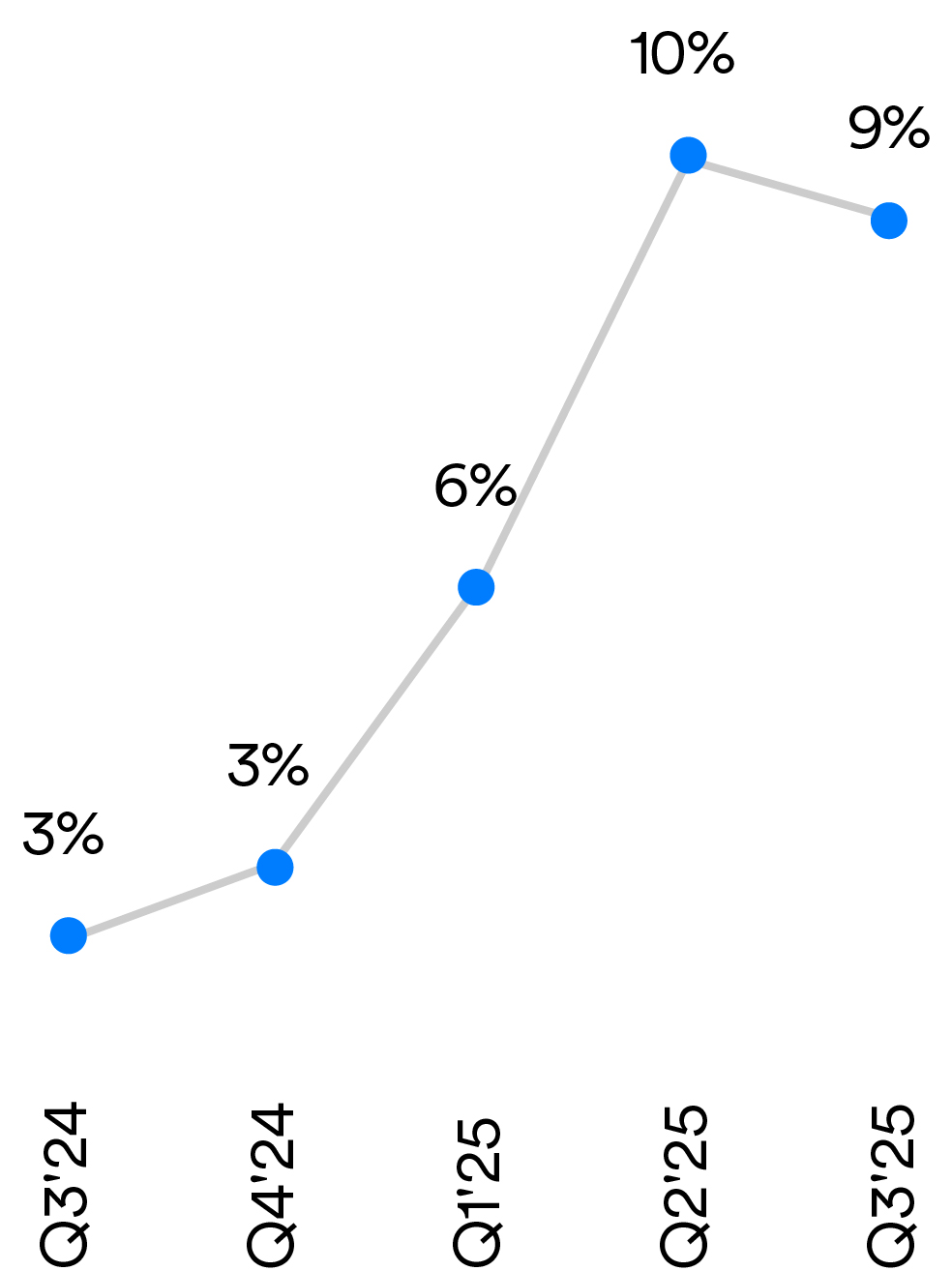
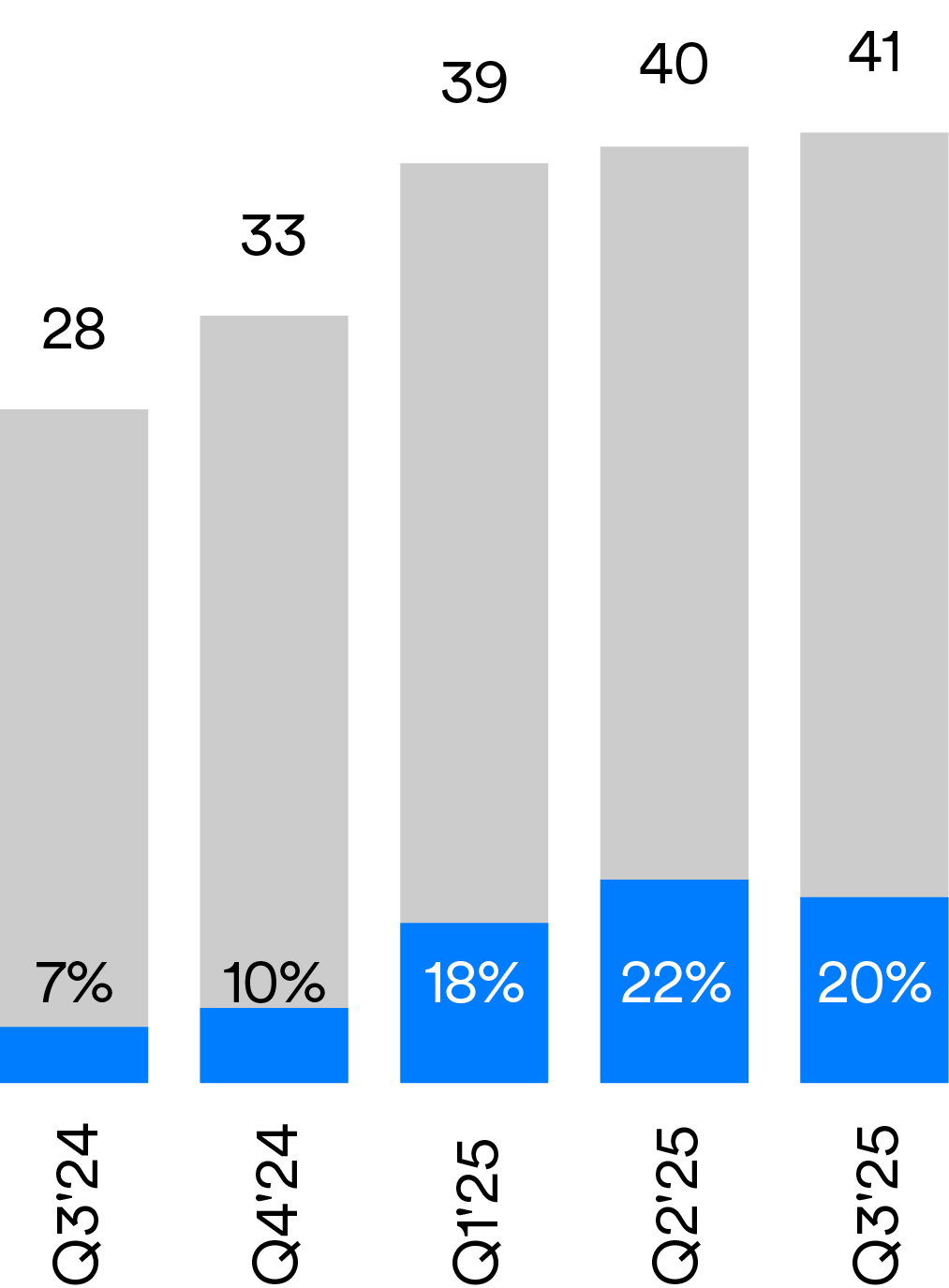
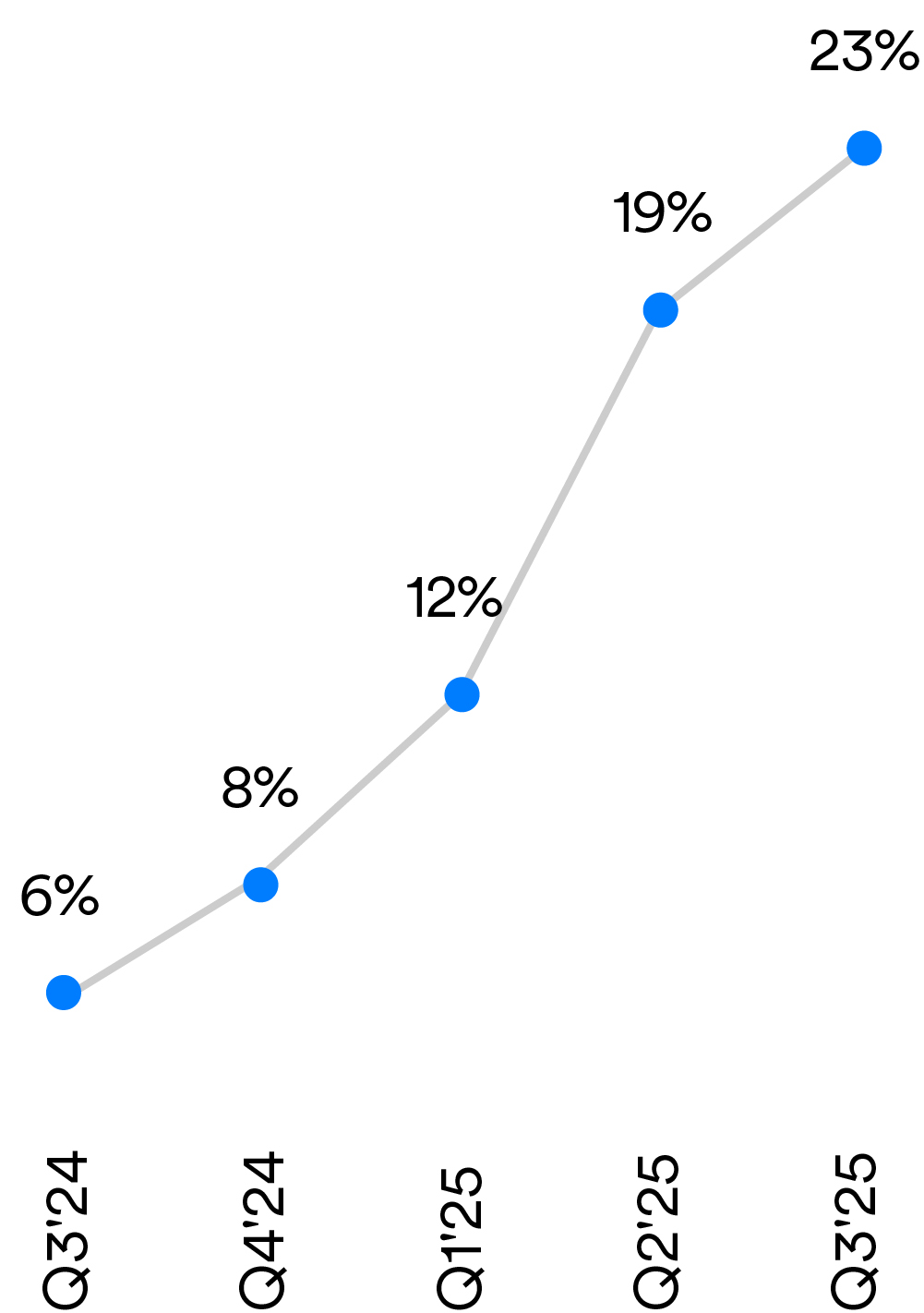
USDC continues to play an important, growing role in the growth and maturation of digital asset markets, with the share of spot trading volume tripling year-over-year through the third quarter of 2025. USDC’s share of perpetual futures open interest on major exchanges rose dramatically, as did the amount of USDC major exchanges held in custody for customers.
USDC’s role in digital asset markets
USDC share of spot trading volumes¹⁸
Binance stablecoin assets held in custody for customers ($B)¹⁹
Binance and Hyperliquid USDC perps open interest share²⁰
Tokenized markets for traditional assets such as government securities, commodities, private credit, and more, also expanded in 2025.21 Tokenized money market funds (TMMFs) show particular promise and have more than doubled in size during the past year.22 While these volumes remain small relative to traditional markets, the infrastructure to scale these instruments is now operational, with durable linkages between regulated stablecoins and mainstream financial institutions from Wall Street to Main Street now in place.
To date, much of the activity in tokenized assets has been led by digital asset managers seeking to diversify into traditional financial instruments. But as the benefits of tokenization become clearer, including faster settlement, greater transparency, more efficient price discovery, and broader accessibility, interest is expanding across traditional institutions.
In private credit, tokenized markets could jumpstart secondary trading and enhance liquidity for a critical source of business funding with an addressable market that could potentially reach more than $30 trillion in the US alone.23
Repo markets are also beginning to shift. Major financial institutions have now completed transactions borrowing USDC against tokenized Treasuries outside of standard trading hours.24 This trading demonstrates early movement toward both intraday and 24/7 repo settlement, a foundational step in modernizing institutional finance beyond the limits of legacy settlement rails and banking hours.
US regulators are taking steps to help ensure this cross-pollination of traditional and digital asset markets scales responsibly. In July 2025, the President’s Working Group on Digital Asset Markets released a landmark report that is guiding the development of this technology in the US.25 SEC Chair Paul Atkins announced Project Crypto “to modernize the securities rules and regulations to enable America’s financial markets to move onchain,”26 with a task force led by SEC Commissioner Hester Peirce.
In August 2025, Commodity Futures Trading Commission (CFTC) Acting Chair Caroline Pham announced a policy sprint “for implementation of the recommendations in the President’s Working Group on Digital Asset Markets report” and to coordinate with the SEC’s Project Crypto.27 Together, these policy initiatives can facilitate the creation of new types of token-based assets. They are also accelerating the migration of traditional assets onchain, thus creating a generational opportunity to upgrade the plumbing of the world’s deepest, most liquid capital markets.
As new standards emerge for tokenizing equities, fixed income, and other underlying assets, regulated stablecoins like USDC are already finding opportunities in traditional markets. These include use cases in derivatives tied to interest rates, commodities, FX, and more, where the benefits of internet-native settlement can be realized today.
In December 2025, CFTC Chair Pham announced a tokenized collateral and stablecoins initiative, with USDC playing a critical role.28 USDC is well positioned for several margin use cases within CFTC regulated markets, including variation margin (VM) posted each day as derivatives positions are marked to market, and initial margin (IM), which is posted when contracts are opened. As the world moves toward 24/7 markets, always-on collateral can help reduce risks, increase transparency, and strengthen resilience in both cleared and uncleared derivatives markets globally.
As capital markets evolve toward a future in which traditional and digital assets increasingly work together, few institutions have been as thoughtful and strategic as BNY. With a history spanning more than 240 years and nearly $60 trillion in assets under custody and/or administration, BNY brings global scale, innovative infrastructure, and deep trust to lead this transition. Its early entrance into digital asset custody reflected not a pivot, but an extension of the company’s long-standing mandate: safeguarding client assets while enabling access to emerging markets and technologies.
BNY launched its digital asset custody platform in 2022, becoming the first Global Systemically Important Bank to offer this service to institutional clients. Today, BNY’s integrated platform offers secure safekeeping of Bitcoin and Ether, while creating an onramp to broader tokenization, payments, and collateral services. Beyond acting as a custodian, BNY is providing its clients with interoperability between traditional and digital finance, ensuring they can manage both traditional and digital assets within a single, consolidated environment.
“Today’s market evolution is not about blockchain technology immediately replacing traditional systems, it is about the two working in concert to unlock new possibilities. At BNY, we are committed to building the infrastructure of the future by bringing together traditional and digital financial ecosystems for our clients. Our deep relationship with Circle is a testament to this strategy as we support the continued growth and adoption of USDC and jointly power the future of markets around the world,” says Carolyn Weinberg, Chief Product and Innovation Officer at BNY.
This approach reflects a broader inflection point for capital markets, where trust, transparency, and operational discipline meet innovation, programmability, and global interoperability. As tokenization scales, the ability to connect traditional and digital assets will become a precondition for even greater market efficiency. BNY’s strategy to deliver safety, speed, and resilience will help ensure it plays a central role in the transformation of capital markets infrastructure.
Today’s market evolution is not about blockchain technology immediately replacing traditional systems, it is about the two working in concert to unlock new possibilities
On the crypto-native side of the capital markets innovation spectrum is Hyperliquid. Since its launch in 2023, Hyperliquid has emerged as one of the most important onchain derivatives exchanges, powered by a unique high-performance order-book model with 70 millisecond block times. Hyperliquid’s ability to replicate the latency and liquidity profile of centralized exchanges (CEXs) while remaining non-custodial marked a big step forward for onchain markets. Since it debuted, Hyperliquid has handled more than $3 trillion in total trading volume across more than 200 digital asset pairs, with significant growth throughout 202529 while demonstrating resilience across various market cycles.
USDC has played a central role in the Hyperliquid ecosystem since the beginning. It is the primary stablecoin on the platform with nearly $4 billion in circulation.30 In September 2025, Circle announced a deeper partnership with the Hyperliquid community that includes the introduction of native USDC on HyperEVM and the implementation of Cross-Chain Transfer Protocol (CCTP) v2, which enables Hyperliquid users to benefit from seamless USDC mobility across blockchain ecosystems. Hyperliquid users will also be able to directly mint and redeem USDC within the ecosystem.31
Circle has also taken on the role of a direct stakeholder by acquiring native Hyperliquid tokens and announced a comprehensive strategy to support HyperEVM developers with funding, tooling, and liquidity. For developers, this means the ability to build financial primitives, apps, and services directly on HyperEVM using the world’s largest regulated stablecoin.
According to Jeff Yan of Hyperliquid Labs, “USDC has been foundational to us since day one. As Hyperliquid grows to become the blockchain to house all finance, the reliability and trust behind USDC have enabled traders and developers alike to operate confidently. The integration of USDC across HyperEVM and HyperCore will be an important onboarding funnel that taps into the deep global liquidity that Circle has worked hard to foster.”
USDC has been foundational to us since day one. As Hyperliquid grows to become the blockchain to house all finance, the reliability and trust behind USDC have enabled traders and developers alike to operate confidently.
14. As of December 18, 2025. See https://coinmarketcap.com/etf/bitcoin/.
15. As of December 18, 2025. See https://coinmarketcap.com/etf/ethereum/.
16. “SEC Permits In-Kind Creations and Redemptions for Crypto ETPs.” U.S. Securities and Exchange Commission. July 29, 2025. Retrieved from: https://www.sec.gov/newsroom/press-releases/2025-101-sec-permits-kind-creations-redemptions-crypto-etps.
17. “JPMorgan to Allow Bitcoin and Ether as Collateral in Crypto Push.” Bloomberg. Emily Nicolle. October 24, 2025. Retrieved from: https://www.bloomberg.com/news/articles/2025-10-24/jpmorgan-to-allow-bitcoin-ether-as-collateral-in-crypto-push?embedded-checkout=true.
18. The Block Research as of September 30, 2025. Figures represent the simple average percentage of spot trading volume denominated in USDC for the three months of each respective quarter. Exchanges included are Binance, Poloniex, Bitfinex, Huobi, OKX, Bittrex, Coinbase, Kraken, and Bitstamp.
19. Binance monthly Proof of Reserves (PoR) as of October 1, 2025 (Q3’25), July 1, 2025 (Q2’25), April 1, 2025 (Q1’25), January 1, 2025 (Q4’24), and October 1, 2024 (Q3’24). Includes fiat stablecoins only.
20. Figures based on the 30 day average up to quarter end. Represents share of total open interest for contracts settled in USDC relative to total open interest for contracts settled in either USDC or USDT.
21. See https://app.rwa.xyz/.
22. As of December 18, 2025. See https://app.rwa.xyz/treasuries.
23. “The next era of private credit.” McKinsey & Company. September 24, 2024. Retrieved from: https://www.mckinsey.com/industries/private-capital/our-insights/the-next-era-of-private-credit.
24. “Treasuries Go 24-7 as Repo Trade Hits Blockchain on a Saturday.” Bloomberg. Katherine Doherty and Muyao Shen. August 12, 2025. Retrieved from: https://www.bloomberg.com/news/articles/2025-08-12/treasuries-go-24-7-as-repo-trade-hits-blockchain-on-a-saturday.
25. See https://www.whitehouse.gov/crypto/.
26. “American Leadership in the Digital Finance Revolution.” U.S. Securities and Exchange Commission. Paul Atkins. July 31, 2025. Retrieved from: https://www.sec.gov/newsroom/speeches-statements/atkins-digital-finance-revolution-073125.
27. “Acting Chairman Pham Announces Next Crypto Sprint Initiative.” Commodities Futures Trading Commission. August 21, 2025. Retrieved from: https://www.cftc.gov/PressRoom/PressReleases/9109-25.
28. “CFTC Issues New Guidance to Provide Regulatory Clarity, Eliminates Outdated Requirements that Hurt Innovation.” Commodities Futures Trading Commission. December 8, 2025. Retrieved from: https://www.cftc.gov/PressRoom/PressReleases/9146-25.
29. Hyperliquid data as of November 13, 2025
30. As of December 18, 2025.
31. “Circle and USDC Expansion with Hyperliquid.” Circle. September 16, 2025. Retrieved from: https://www.circle.com/blog/circle-and-usdc-expansion-with-hyperliquid.
This marketing communication is issued by Circle Internet Financial Europe SAS, a licensed Electronic Money Institution under n°17788 and registered Digital Assets Services Provider in France under n°E2024-111.
White Papers relating to electronic money tokens that we issue in the European Economic Area (EEA) ("EMT") are published and available on our Website. Holders of EMT have the right of redemption against the issuer at any time and at par value.
Contact: Web: https://www.circle.com | Email: [email protected] | Phone number : +33 (1) 59000130